Skip to content

Colombia Digital Nomad Visa 2026: The Complete Guide
Colombia has become the most popular digital nomad destination in Latin America — and for good reason. The cost of living is low, the food is excellent, the internet in Medellín and Bogotá rivals most European cities, and the people are genuinely welcoming. What makes Colombia stand out from other hotspots is that its visa program actually works. No bureaucratic black hole, no mysterious denials, no six-month waits. Apply online, get an answer in two weeks, live legally for up to two years.
This guide covers everything: the official requirements, the documents you need, a step-by-step walkthrough of the application, a full cost breakdown, the tax implications nobody talks about, and what the process is actually like in practice. If you’re already thinking about planning your trip to Colombia, keep reading — this visa might be the easiest legal decision you make all year.
What Is the Colombia Digital Nomad Visa?
Officially called the “V – Digital Nomad” visa, it was launched in October 2022 under Resolution 5477 — one of the first structured digital nomad visa programs in Latin America. Colombia wasn’t just following a trend; they built something functional.
The visa lets you live legally in Colombia for up to two years as a remote worker. You can work for any foreign employer, run your own freelance business, or manage clients abroad — the one thing you cannot do is earn income from a Colombian company. That distinction is important: it’s designed for people whose money comes from outside Colombia.
Structurally, it’s a Type V (Visitor) visa, not a resident visa. That matters for two reasons. First, it’s easier to get than a resident visa. Second, your time on it does not count toward permanent residency. If you’re thinking long-term about Colombia, you’d eventually need to transition to a different visa category. For most nomads, that’s a non-issue — two years is the whole plan, and this visa handles it cleanly.
The visa is renewable, so if two years from now you’re still in Laureles or El Poblado and don’t want to leave, you can apply again.
Requirements & Eligibility
Income Requirements
You need to demonstrate a minimum monthly income of three times Colombia’s monthly minimum wage. In 2026, that threshold sits at roughly $1,050 USD/month — but verify the current figure before you apply, since Colombia adjusts its minimum wage annually in January.
The three-month window is what matters most. Colombia wants to see consistent, recent income — not a one-time payment, not projections, not promises. Bank statements showing regular deposits work well. So does an employment contract with your salary clearly stated. Freelancers can use client invoices alongside bank statements showing the corresponding deposits.
The income just needs to be from a foreign source. If you’re making $2,000/month from clients in the US, Canada, or Europe, you’re well above the threshold. If your income is variable month-to-month, average it out and make sure your documentation reflects that clearly.
Documents You’ll Need
- Valid passport with at least 6 months of validity remaining
- Passport-quality photo: white background, 3x4cm
- Health insurance valid in Colombia for the full duration of the visa
- Proof of income: bank statements from the last 3 months, employment contract, or client invoices
- Motivation letter explaining your remote work situation and why you want to live in Colombia
- Apostilled documents, if required — this depends on your country of citizenship (check with your consulate)
The motivation letter doesn’t need to be a literary masterpiece. One page explaining who you work for, what you do, and that you intend to live in Colombia while continuing that remote work. Keep it factual and professional.
Health Insurance
This is non-negotiable: your health insurance must be valid in Colombia for the entire duration of the visa you’re requesting. If you apply for two years, your insurance needs to cover two years — or you need to commit to renewing it annually and show documentation of that plan.
You have options. Colombian health insurance providers are accepted, and international plans work as long as Colombia is explicitly listed as a covered country. SafetyWing is widely used by nomads applying for this visa because their Nomad Insurance plan covers Colombia specifically, runs continuously month-to-month, and costs around $45/month — roughly $540/year. World Nomads is another solid option, though it tends to run slightly higher depending on your age and home country.
Whatever you choose, make sure the insurer can provide a certificate or letter confirming coverage in Colombia. The application system requires proof, not just a policy number.
How to Apply (Step-by-Step)
Step 1 — Create Your Cancilleria Account
The entire application happens online at tramitesmre.cancilleria.gov.co — Colombia’s Ministry of Foreign Affairs visa portal. Start by creating an account and verifying your email. The site is in Spanish. If your Spanish isn’t solid, open it in Chrome and use the built-in translation — it’s accurate enough to navigate without confusion.
Step 2 — Fill Out the Online Application
Once logged in, select “Visa Tipo V” and then “Nomada Digital” from the visa category list. You’ll work through sections covering personal information, your passport details, intended travel dates, and your employment situation. Have your passport open in front of you — the system asks for specific fields from the bio page. The form has an inactivity timer and will log you out if you leave it idle too long. Fill it in one sitting if you can.
Step 3 — Upload Documents
Scan everything as PDF. Each file needs to be under 5MB. This is where people run into trouble: the system silently fails on oversized uploads — no error message, just nothing happens. Compress your scans before uploading. Upload your passport bio page, your photo, your insurance certificate, your income proof, and your motivation letter. Review each upload confirmation before moving on.
Step 4 — Pay the Fee
The application processing fee is approximately $52 USD, paid online via credit or debit card. This fee is non-refundable — if your application is denied, you don’t get it back. Make sure everything is in order before you pay.
Step 5 — Wait for Approval
The official processing timeline is up to 30 calendar days. In practice, most applicants hear back within 5 to 15 business days. You’ll receive an email notification when a decision is made. If approved, download your visa sticker PDF immediately and save it in multiple places — you’ll need to print it and present it at the border.
Step 6 — Get Your Cedula de Extranjeria
The visa is not your finish line. Within 15 days of arriving in Colombia, you need to register with Migración Colombia and apply for your Cedula de Extranjería — your foreign ID card. Cost is approximately $230,000 COP (~$55 USD). You’ll do this at a Migración Colombia office; Bogotá and Medellín both have multiple locations, and appointments book out, so schedule early.
The Cedula matters. It’s your official form of identification inside Colombia. You’ll need it to get a local SIM card, open a bank account, sign a lease, register at a gym — anything that requires local ID. Don’t skip it or delay it.
Costs Breakdown
Here’s what the visa actually costs you in year one, all-in:
| Item | Cost |
|---|---|
| Visa application fee | ~$52 USD |
| Cedula de Extranjería | ~$55 USD |
| Health insurance (annual, SafetyWing) | ~$540–600 USD |
| Apostilles (if required, per document) | $20–50 USD |
| Total first year | ~$670–760 USD |
Put that number in context. The alternative — tourist visa runs, leaving Colombia every 180 days — means flights to Lima, Quito, or Panama City at $150–300 round trip per exit. Do that twice and you’ve already spent more than the nomad visa costs for two full years of legal residency. The math isn’t close.
Tourist Visa vs. Digital Nomad Visa vs. Cedula — Which One Do You Need?
This is the question nobody answers clearly, so let’s fix that. Colombia gives you three realistic paths as a remote worker, and picking the wrong one costs you money, legal standing, or both.
| Feature | Tourist Visa (Stamp) | Digital Nomad Visa (V) | Cedula (M/R Visa) |
|---|---|---|---|
| Duration | 90 days, extendable to 180 | Up to 2 years | 1–5 years |
| Work legally? | No (gray area) | Yes, for foreign employers | Yes, including Colombian employers |
| Cost | Free (visa-exempt countries) | ~$107 total | $200–400+ |
| Taxes | Not if under 183 days | Complex — see below | Full Colombian taxes |
| Counts toward residency? | No | No | Yes (M visa → R visa) |
| Can open bank account? | Difficult | Yes, with Cedula | Yes |
| Renewability | Leave and re-enter | Yes, online | Yes |
| Best for | Short trips, testing the waters | 6–24 month stays | Long-term commitment |
If you’re coming for under three months to figure out whether Colombia actually works for you — take the tourist stamp. You’ll get 90 days on arrival from most Western passports, and you can extend to 180 days at a Migración Colombia office. Cost: nearly nothing. Downside: you can’t legally work, and banking is a pain.
The digital nomad visa is the sweet spot for most people. At roughly $107 all-in, it’s legitimately cheap. You get up to two years, you can work remotely for foreign clients legally, and you get a Cedula de Extranjería — the ID card that unlocks a real bank account, a SIM card without jumping through hoops, and a dozen other practical things. The catch: it doesn’t count toward permanent residency, and the 183-day tax rule still applies.
The Cedula path via an M or R visa is for people making a real commitment. It costs more, requires more documentation, and puts you inside the Colombian tax system fully — but it’s the only route to permanent residency and the only way to work for Colombian employers. Most nomads don’t need this.
The math that matters: if you’re planning 6+ months in Colombia, the nomad visa pays for itself almost immediately. A tourist run to Ecuador or Panama costs $300–600 in flights and hotels. The nomad visa costs $107 once and covers two years.
Taxes as a Digital Nomad in Colombia
Nobody wants to talk about this part. Most guides skip it entirely or drop a vague “consult a professional” and move on. Here’s what you actually need to understand.
Disclaimer: This is general information, not tax advice. Tax law is complex and depends on your home country, income structure, and time spent in Colombia. Consult a qualified accountant for your specific situation.
The 183-Day Rule
Colombia uses a 183-day threshold to define tax residency — and this applies to everyone, regardless of visa type. Spend 183 or more days in Colombia within a calendar year (January to December), and you become a Colombian tax resident. That means your worldwide income is subject to Colombian income tax.
The rates are graduated: effectively 0% on the first roughly $10,000 USD equivalent, climbing to 39% at the top end. The 183 days don’t have to be consecutive — Colombia counts cumulative days within the calendar year.
Do You Need to File in Colombia?
Under 183 days: generally no Colombian tax obligation on foreign-sourced income. You’re a non-resident, and your money earned outside Colombia stays outside Colombia’s tax reach.
Over 183 days: you’re in more complicated territory, and you should talk to a Colombian contador (accountant) before the fiscal year closes. Many nomads deliberately structure their stays to avoid this threshold — they leave for December, or split their year between Colombia and another country. It’s a real strategy that real people use.
Double Taxation Agreements
Colombia has tax treaties with Spain, Canada, Switzerland, Mexico, Chile, Portugal, and a handful of others. These agreements prevent double taxation on the same income.
Notably missing: the United States, the United Kingdom, Germany, France, and Australia. If you’re from one of those countries and hit 183 days, you could face tax obligations in both places simultaneously. Most countries offer foreign tax credits — but you need to file correctly in both jurisdictions.
Bottom line: if you’ll be in Colombia 183+ days, budget $200–500 for a local accountant. It’s one of the better investments you’ll make.
Cost of Living as a Digital Nomad in Colombia
The numbers online range from suspiciously low to weirdly high. Here’s a grounded breakdown for 2026.
Medellín vs. Cartagena vs. Bogotá
| Expense | Medellín | Cartagena | Bogotá |
|---|---|---|---|
| 1BR apartment (furnished, nice area) | $500–800 | $600–1,000 | $450–700 |
| Coworking (monthly) | $80–150 | $100–180 | $70–130 |
| Groceries | $150–200 | $180–250 | $140–190 |
| Eating out (daily lunch menu) | $3–5 | $4–6 | $3–5 |
| Transportation | $30–50 | $40–70 | $25–40 |
| Gym membership | $25–40 | $30–50 | $20–35 |
| Mobile data (30GB) | $10–15 | $10–15 | $10–15 |
| Monthly total | $800–1,250 | $960–1,570 | $720–1,110 |
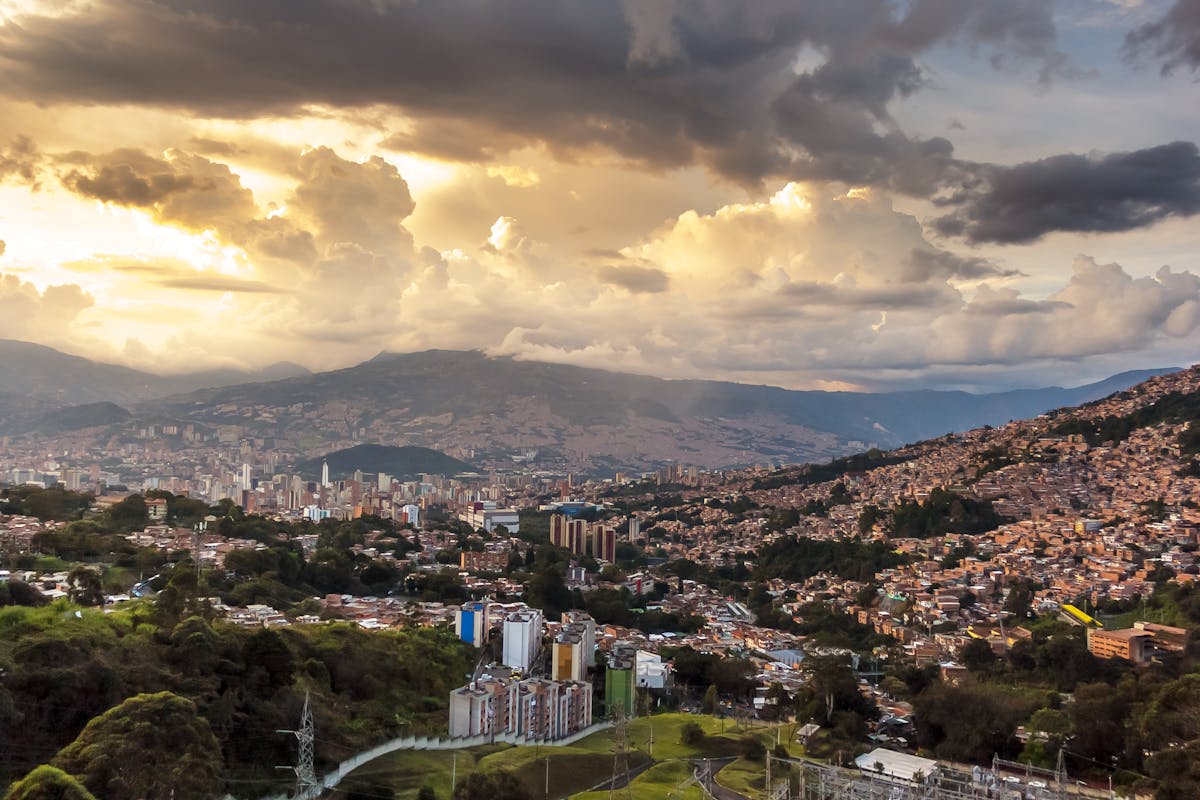
Medellín is the default for a reason. The weather is the best in the country — low 70s Fahrenheit year-round, no brutal humidity, no cold winters. El Poblado and Laureles are built for remote workers: fast internet, good coworking, reliable power, walkable neighborhoods. And the nomad community is large enough that you won’t spend your first week figuring everything out alone.
Cartagena is beautiful but more expensive and hot — better suited to a 1–3 month stay than a year-round base. Internet is spottier: 30–60 Mbps in apartments versus 50–100 Mbps in Medellín and Bogotá. Good coworking spaces exist with backup connections, so it’s workable, just not effortless.
Bogotá is the cheapest and most underrated. It’s a real city with a food scene that runs circles around anywhere else in Colombia. The downsides: 8,600 feet elevation (you’ll feel it), cold and gray weather. If you like urban living and don’t need beach access, Bogotá makes a strong case. For where to stay in Colombia across all three cities, the gap between budget and upscale is smaller than you’d expect.
Best Cities for Digital Nomads in Colombia
The visa gets you into Colombia — but where you land matters more than most guides admit.
Medellín — The Default Choice
El Poblado is the obvious first stop — English menus, walkable rooftop bars, everything within a few blocks. It’s also overpriced and feels more like a resort neighborhood than a real city. If you’re staying longer than a month, you’ll probably migrate to Laureles. The vibe is more local, the rent is lower, the street food is better, and you’re still 20 minutes from everything.
Coworking is strong: Selina, WeWork, Tinkko, and Epicentro run $80–150/month. Apartments average 50–100 Mbps, fiber is available on longer leases, and the metro is one of the best in Latin America at $0.70 a ride. For a deeper look, check out the full guide to things to do in Medellín.
Bogotá — For the Grinders
Chapinero and Usaquén are the nomad neighborhoods — solid cafes, good transit, access to whatever you need. The food scene is legitimately the best in the country. The altitude (8,600 ft) hits you the first week. The weather is gray. But if you’re grinding on a deadline, there’s nothing pulling you outside anyway.
Cartagena — Beach + Work
Works best in 1–3 month stints. Getsemaní is where you want to be: walkable, affordable, creative energy. Plan around the WiFi — it’s less reliable than Medellín or Bogotá. Always have a backup hotspot for heavy call days. Full rundown in the guide to things to do in Cartagena.
Santa Marta & the Caribbean Coast
The emerging option. Cheaper than Cartagena, less crowded, genuinely laid back. Coworking infrastructure is thinner and internet can be inconsistent — bring a quality hotspot. The real draw is lifestyle: Tayrona National Park for weekend escapes, less commercialized beaches, and your money goes further. Best for nomads who can work asynchronously and don’t need calls all day.
What It’s Actually Like
I moved from Montreal to Medellín in the middle of winter. One day I was scraping ice off my car at minus fifteen, three days later I was drinking a tinto on a patio in 24-degree sunshine. That contrast alone buys Colombia a lot of goodwill in the first week.
The cost difference hits just as fast. A coffee in Montreal runs five, six Canadian dollars. In Medellín, I was paying 3,000 COP — less than a dollar. My entire food budget for a week cost what I’d spend in two days back home.
I started in an Airbnb in Laureles. After two weeks I found a furnished apartment through a local property manager — about 40% cheaper for twice the space. That’s a pattern worth knowing: the Airbnb gets you in the door while you learn the neighborhood, then you switch. Don’t commit long-term until you know the area.
The working routine settled naturally. Mornings at a cafe — most in Laureles have reliable WiFi and don’t mind three-hour sessions. Afternoons at a coworking space when I had calls or needed focus. The timezone is perfect: Colombia runs on EST year-round (no daylight saving), so if your clients are in the US or Canada, your workday lines up exactly. Nine AM Eastern is nine AM in Medellín.
The pace of life is a genuine adjustment. Things that take an hour at home take a day. A landlord says noon, shows up at four. It’s not dysfunction — it’s a different relationship with time. You either adapt or spend three months frustrated.
On safety: I felt comfortable overall. Common sense applies — don’t flash expensive gear, stay aware at night. Medellín in 2026 is not the city of the nineties. But you still pay attention, same as any large city you don’t know. The honest breakdown is in the guide on safety in Colombia.
The social side was easier than expected. Coworking spaces are natural meeting points — lunch with the person next to you turns into dinner, and within two weeks you have a loose community. Language exchanges in Laureles and El Poblado are good for meeting locals, not just other nomads.
Colombia isn’t perfect. Air quality in the Medellín valley gets bad some months when inversions trap pollution. Bureaucracy is slow. Some landlords are flaky. I cover the full picture in living in Medellín for 3 months.
But the overall verdict: Colombia is one of the best places in the world to be a digital nomad right now. The cost of living, the infrastructure, the timezone alignment, the quality of life — it stacks up against anywhere. The digital nomad visa just makes it official.
Frequently Asked Questions
Can I work for a Colombian company on the digital nomad visa?
No. The visa is specifically for people working for foreign employers or running their own businesses abroad.
Can I bring my family?
Yes. Your spouse and dependent children can apply for beneficiary visas tied to your digital nomad visa. They’ll each need separate applications through the Cancillería portal.
Can I leave and re-enter Colombia?
Yes. The visa allows multiple entries. Keep your visa PDF and Cedula de Extranjería with you when traveling.
How long does processing take?
Officially up to 30 calendar days. Most applicants get a decision within 5–15 business days.
What happens if my visa is denied?
You lose the application fee (~$52 USD). Common reasons: insufficient income proof, incomplete documents, or health insurance that doesn’t cover the full visa duration. You can reapply after fixing the issues.
Can I switch from a tourist visa to the digital nomad visa while in Colombia?
Yes. You don’t need to leave the country. Apply online through the same Cancillería portal while on your tourist stamp — just make sure it hasn’t expired before the new visa is approved.