So here’s the honest version of things to do in Cartagena, Colombia: I’ve been to Cartagena at least four times since 2021, two long stays that first year and then shorter visits, and I still can’t tell you I’ve done 25 things there. Without taking anything away from Cartagena, a lot of the time it’s the beaches, and those end up being the only places people actually visit. It’s hard for me to say “I did 25 places.” I didn’t.
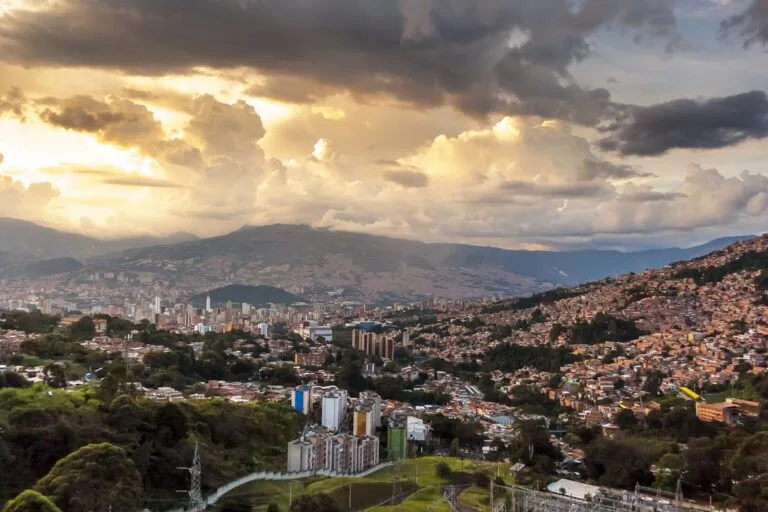
When I first landed in Colombia in 2021, I didn’t know anyone, I didn’t speak Spanish, it was my first time in Latin America, and it was for three months, not one week. All the people said that I am crazy. Cartagena was one of the first trips I took out of Medellín, and I keep going back.
So this guide is split in two. First, 12 things I’ve actually done, with what I liked, what was less fun, and what I paid when I know it. Then a clear section with what I haven’t done yet, written from what other travelers and guides report, so you can tell the difference.
Quick Overview of Cartagena (and the History Most Guides Get Wrong)
Cartagena de Indias sits on Colombia’s northern Caribbean coast. It was one of the most important ports in the Spanish Empire, and today its port, fortresses and old town are listed as a UNESCO World Heritage Site, known for colonial architecture, busy street life, and islands close enough for a day or a night away.
Now, the history part. The first time I walked the walls, in 2021, a local friend was explaining the story to me while I was filming. Her version was basically that the indigenous people were there first, that they built the walls to defend themselves against the Spanish who came for the gold and emeralds, and that the Spanish never managed to conquer Cartagena. I was already doubting out loud on camera, things like “I don’t think it was guns, probably bows and arrows” and “let me know in the comments if I’m wrong.”
And I was right to doubt, because that’s not what happened. Here are the facts, according to UNESCO and standard references like Encyclopaedia Britannica:
- Cartagena de Indias was founded by the Spanish, by the conquistador Pedro de Heredia, in 1533.
- The Spanish built the walls and forts, from the late 16th century through the 18th century, to defend the port against pirates and rival European powers, not against indigenous people.
- The city was actually taken and held for ransom by Francis Drake in 1586.
- The indigenous peoples of the area, including the Kalamari (part of the wider Carib family), were displaced by colonization. They didn’t build the fortifications.
I keep that story in because it’s a good lesson: a friendly local explanation is not a source.
The city splits into distinct neighborhoods, each with its own character. The Walled City (Centro Histórico) is where most tourists spend their time. Getsemaní, just outside the walls, is grittier and more lived-in. Bocagrande is the modern beach strip with high-rises and hotels. And Manga is a quiet residential area with early 20th-century houses that most visitors never see.
For a deeper look at the city’s past, check out our guide to the history of Cartagena.
12 Things to Do in Cartagena (That I’ve Actually Done)
These are the best things to do in Cartagena from my own trips, each one lived. Everything I haven’t done is further down, in its own section.
1. Explore the Walled City (Centro Histórico)
Walk Through Centuries of History
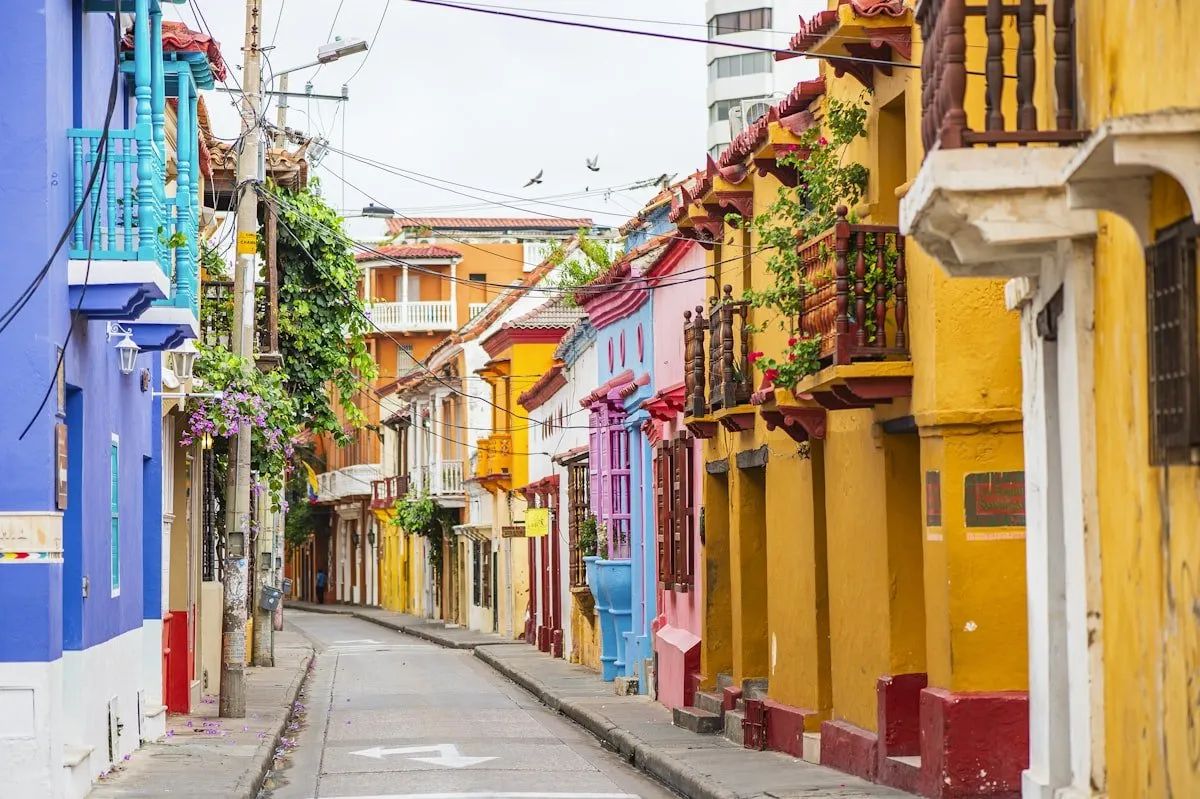
Colonial streets and flower-covered balconies in the Walled City. Get lost on purpose.
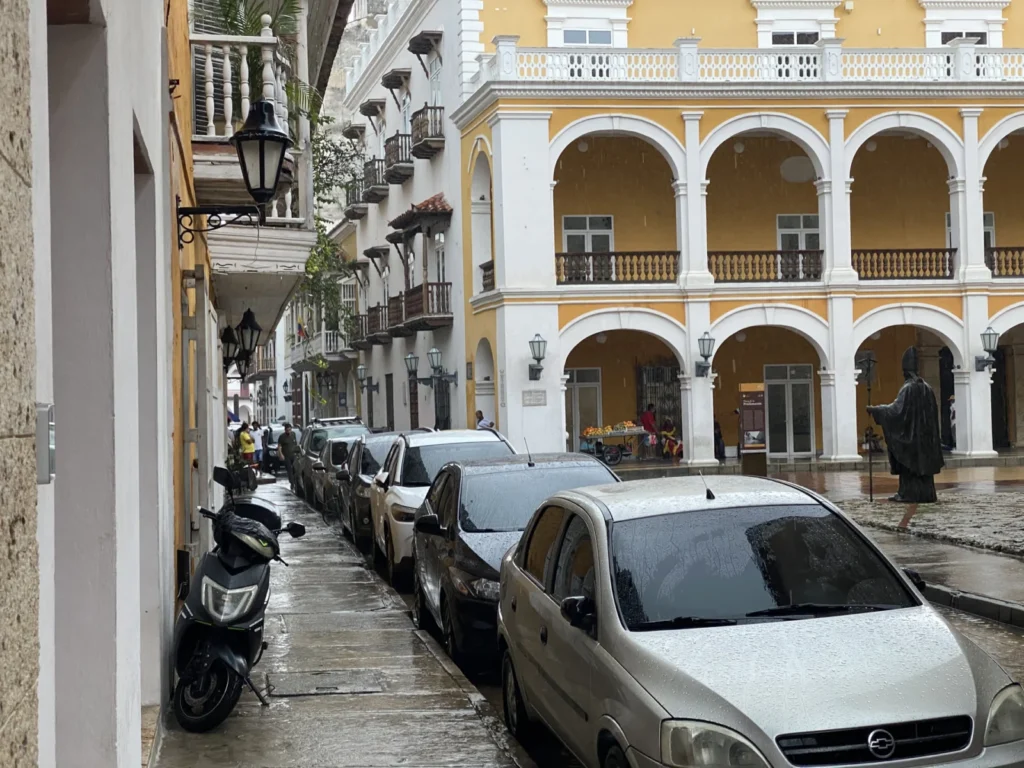
A rainy day in the Walled City, 2021.
The Cartagena walled city is where I stayed on my first trips, right in El Centro, at a corner near Avenida Santo Domingo. So for me this isn’t a day visit, it was my front door. The Centro Histórico is surrounded by thick stone walls that the Spanish built from the late 16th to the 18th century against pirate attacks, and inside it’s a maze of narrow streets with colonial buildings painted every color you can think of. I’m not an architecture guy, but I kept saying it on camera: I like the design of the houses as they are.
Take your time walking through Plaza Santo Domingo, Plaza de Bolívar, and the quieter streets behind the cathedral. The best time to explore is early morning before the heat kicks in, or late afternoon when the light turns golden.
One thing you’ll notice at night: a lot of people dress in white. I asked about it, and a local (my friend translated, he didn’t speak English) explained it’s basically the climate. The heat is heavy, white is comfortable, and families from Medellín come down wearing all white. A white shirt replaces the jacket and tie, and for a wedding you just roll the sleeves down. He was clear there’s no historical meaning, it’s simply more comfortable, and parties of TV artists and Instagram made it even bigger.
What’s less fun: the vendors. They can be very insistent, even after you say no.
Cartagena is one of the most colorful towns in Colombia, and the Walled City is where you’ll see why.
2. Walk the City Walls at Sunset (and Find the Cuevas)
The Best Free Show in Town
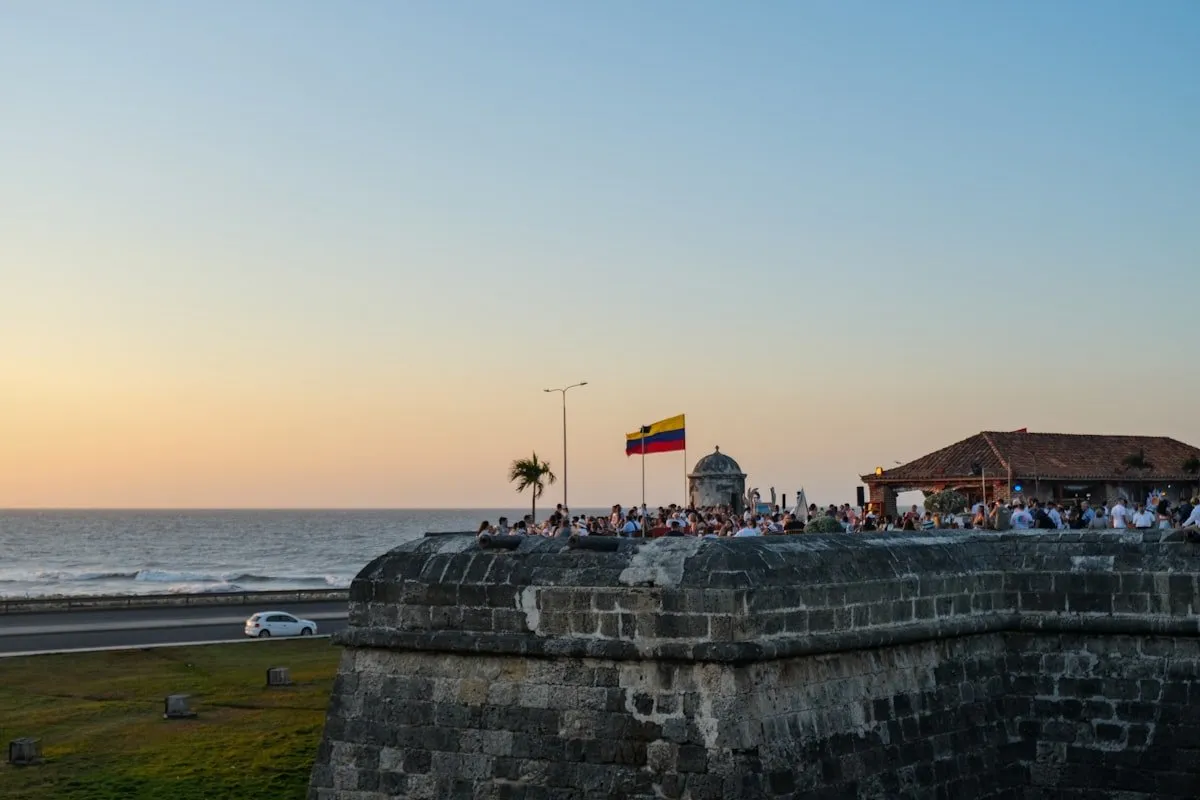
Sunset from the city walls, where locals and travelers gather every evening.
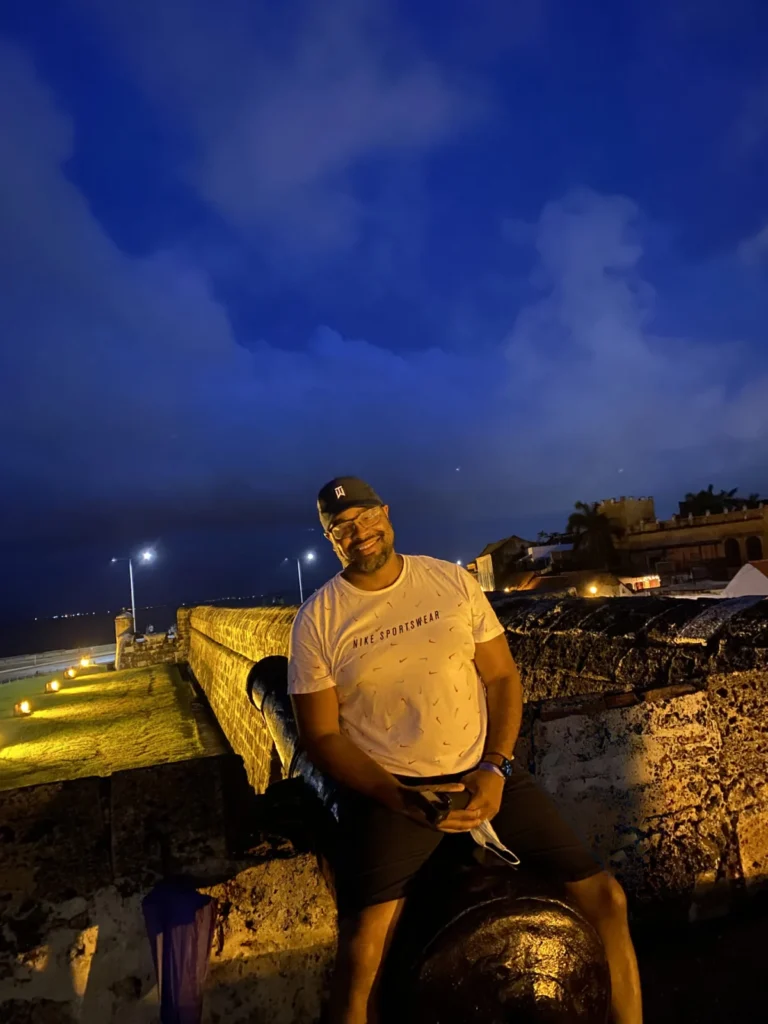
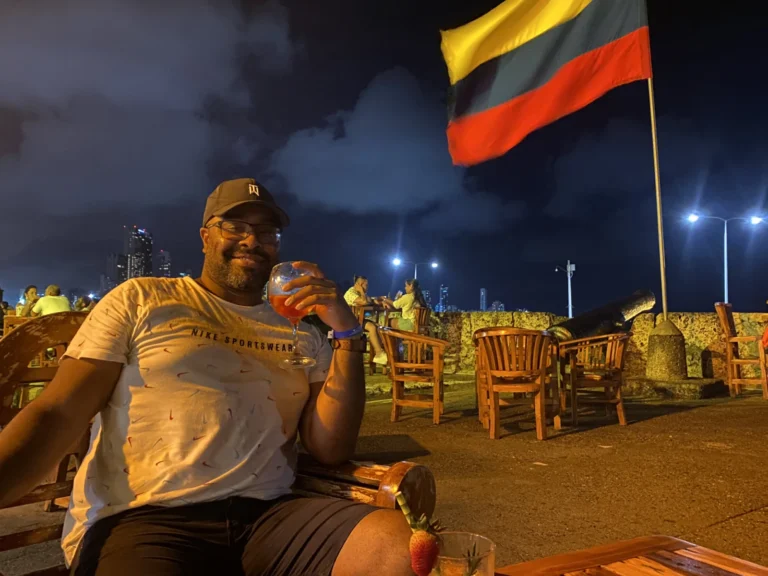
Me on the old fortifications at night, 2021.
The day I filmed the walls, in 2021, we started on Avenida Santo Domingo and my friend just said “let’s go to the walls.” I asked if we could go up, and she took me to a viewpoint she called “one of the most unknown places here,” just for the view. From up there you see the city from above, which is really nice, and I could point at my own hotel, at the corner right there, and a church next to it.
Something I didn’t expect: the Cartagena city walls aren’t a museum. You can walk around on them until a certain point, then a section is closed to the public. And on and along the walls there are houses, restaurants and hotels. There was even a restaurant right in the middle of the wall. I think it has closed since, so I won’t send you there.
My friend also showed me the cuevas, basically small rooms in the wall where they fired the cannons toward the sea. She did the cannon noise, “Powww!”, and we were both laughing. The cannons were actually pretty small.
For the sunset Cartagena is known for, locals and travelers gather near the Café del Mar area. The stretch between the Clock Tower (Torre del Reloj) and the Baluarte de Santo Domingo is the most popular, but you’ll find quieter sections further along. A beer from a street vendor was about 5,000 COP (check before you go, as of 2026). We stayed until it got dark, and on the video I’m saying “it’s getting dark here, I don’t know if you gonna see this well.” Access is free.
3. Spend an Evening in Getsemaní
Street Art, Salsa, and a Different Pace
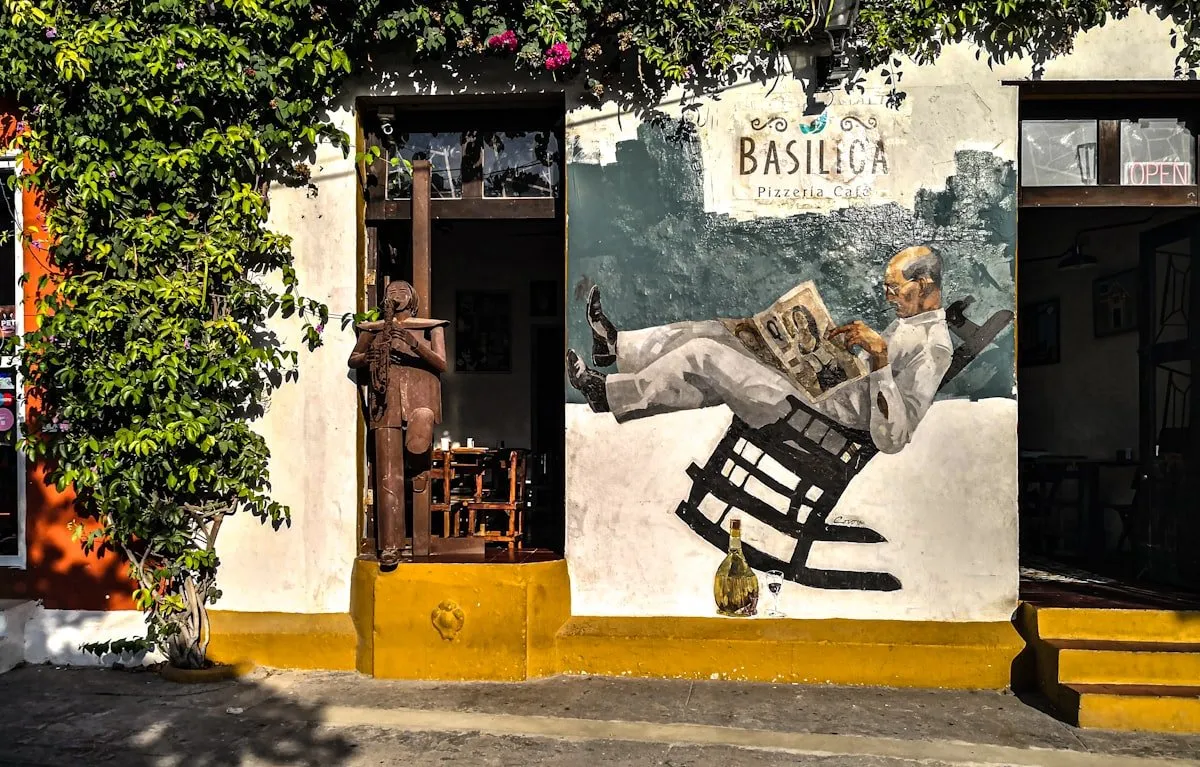
Murals on the facades of Getsemaní. They change often.
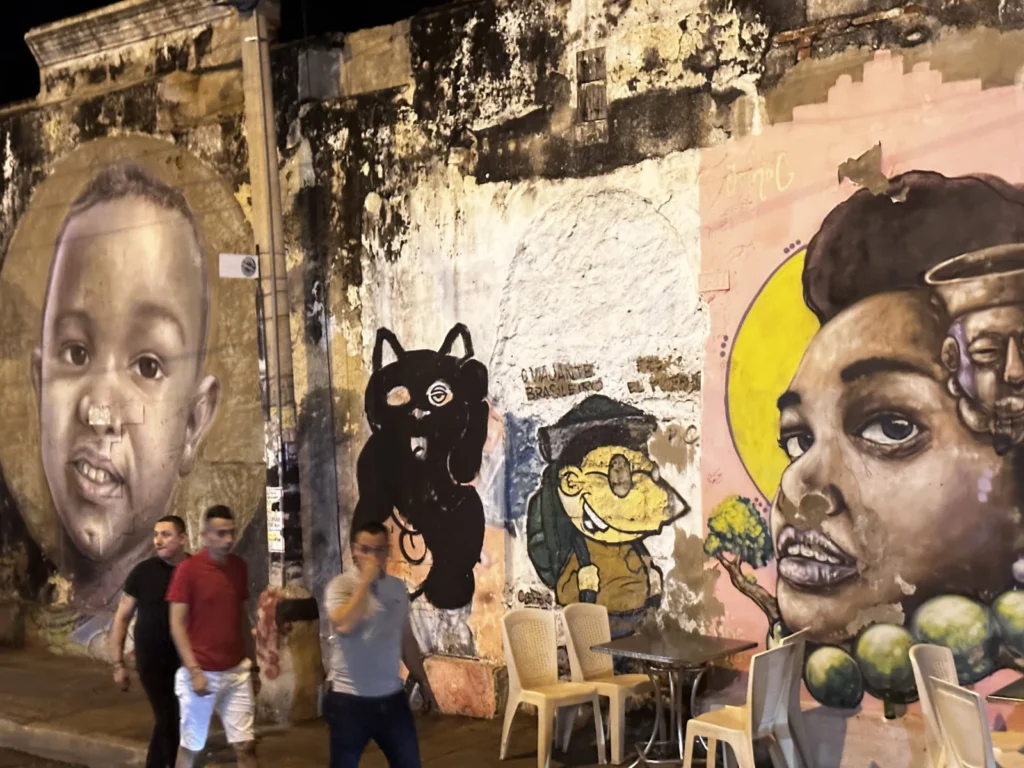
Getsemaní at night, 2023.
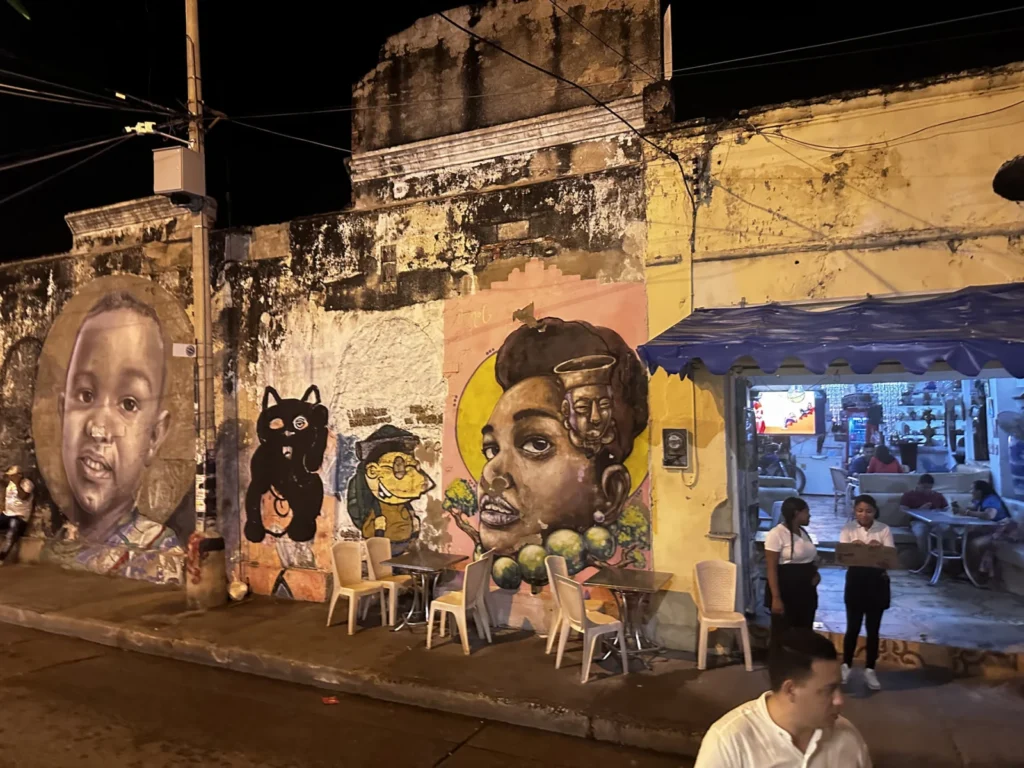
Murals and street tables in Getsemaní, 2023.
I’ve spent evenings in Getsemaní Cartagena several times, and there’s always something going on: little shows in the street at night, like a Michael Jackson impersonator. The mood is chill, a bit different from the zone around the Clock Tower, which feels more like the postcard.
Getsemaní used to be the “rough” neighborhood just outside the city walls. Today the street art covers whole facades, plazas fill up with domino players in the afternoon, and at night the bars and restaurants come alive. Plaza de la Trinidad is the social center, and Calle de la Sierpe and the streets around it have the best murals.
One time, after La Popa, we ate at a typical-food restaurant here, menu by QR code, and I had a sancocho. On camera I said the restaurant was wicked. If you’re on a budget, Getsemaní also has the city’s cheapest hostels and affordable restaurants.
4. Go Up to La Popa (and Find Its Money Museum)
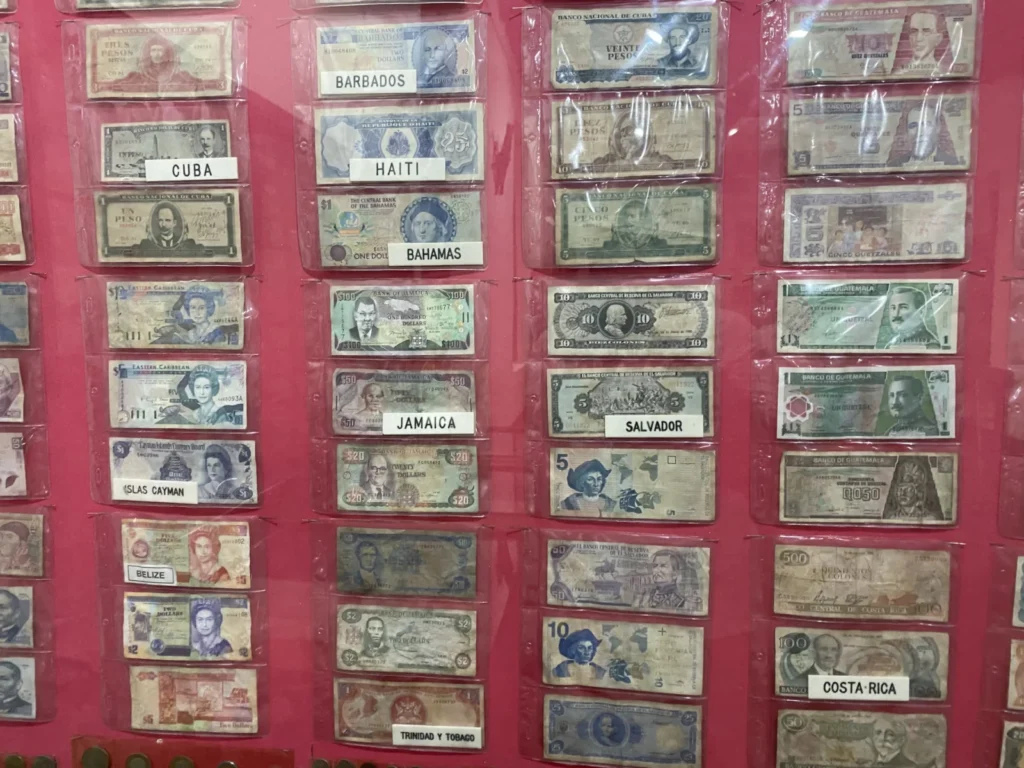
The banknote display at La Popa, 2021.
So I went up La Popa Cartagena-style, by taxi, on a small tour with a driver right before going to the airport. Before I even got out of the car I was saying “now I’m about to get harassed to buy some things,” because there’s a thing I hate here: as soon as you step out, people jump on you to sell something. And I was looking for my camera while it was in my hands. That’s so me.
At the top, you see the whole city, and I just said “wow, look at this.” It’s very beautiful up there. I didn’t know the history and only figured out on site that it’s a church. Inside you can’t really talk loud.
After the church there’s a small money museum with bills from all over: Colombia, Brazil, Peru, Jamaica… and then old Canadian bills, “we don’t even have those dollars anymore,” and a Haitian bill, 25 gourdes. My two worlds in one display case. That’s kind of really cool.
Here’s the visit on my channel:
Entry is listed at about 15,000 COP (as of 2026); my driver estimated 10,000 to 12,000 COP. I didn’t film what I paid, so check before you go. The convent is often dated to 1607 and the road up is widely described as unsafe on foot: take a taxi and negotiate first.
5. See Castillo San Felipe From the Outside (and Los Zapatos Viejos)
The Largest Spanish Fort in the Americas
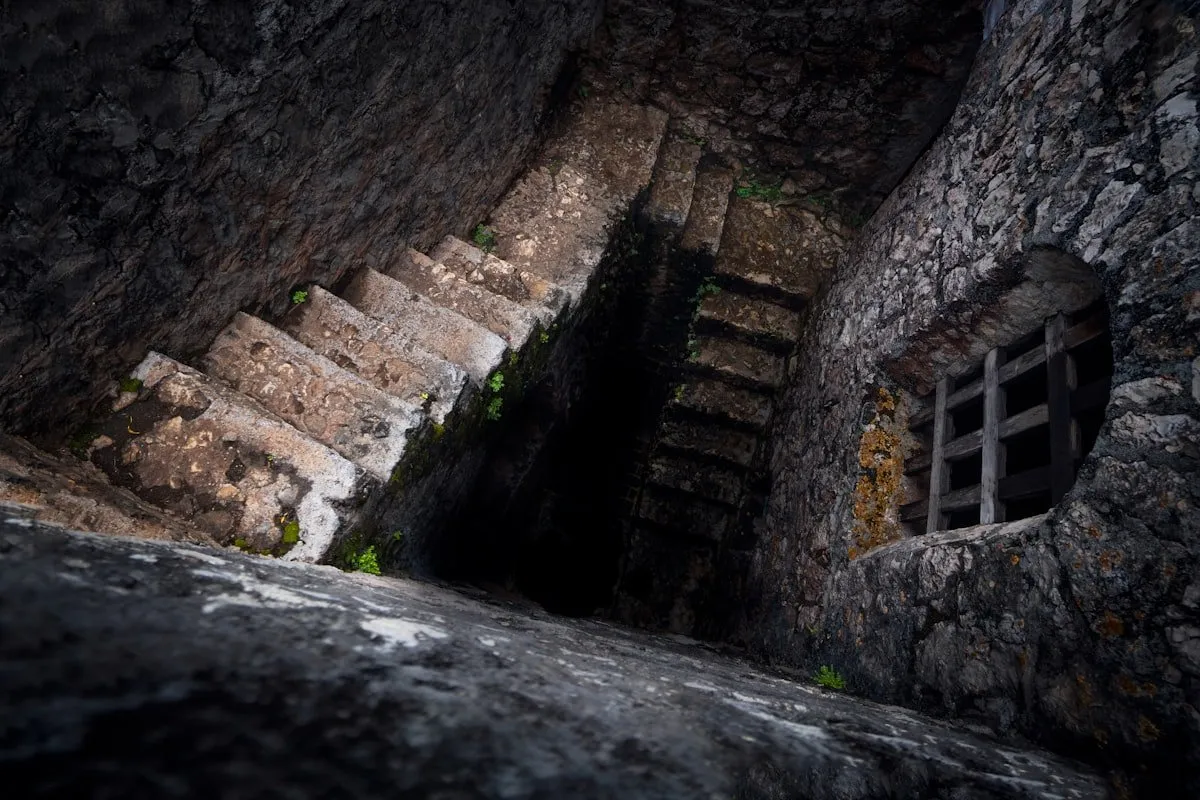
Castillo San Felipe de Barajas on its hill over the city.
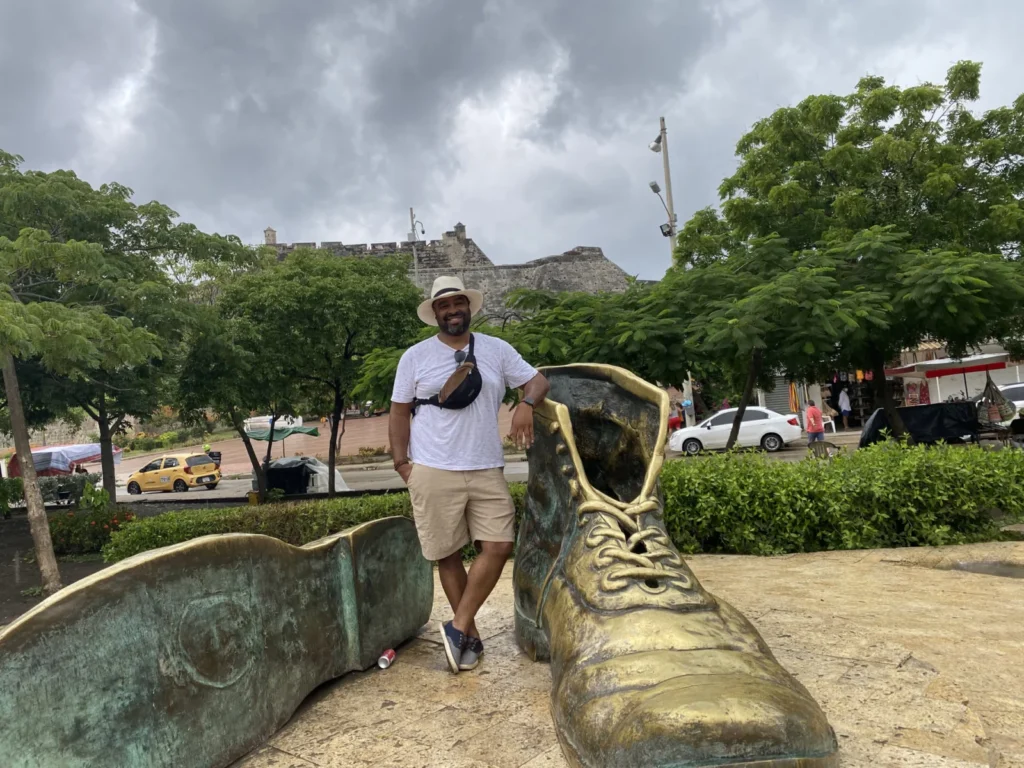
Me next to Los Zapatos Viejos, 2021.
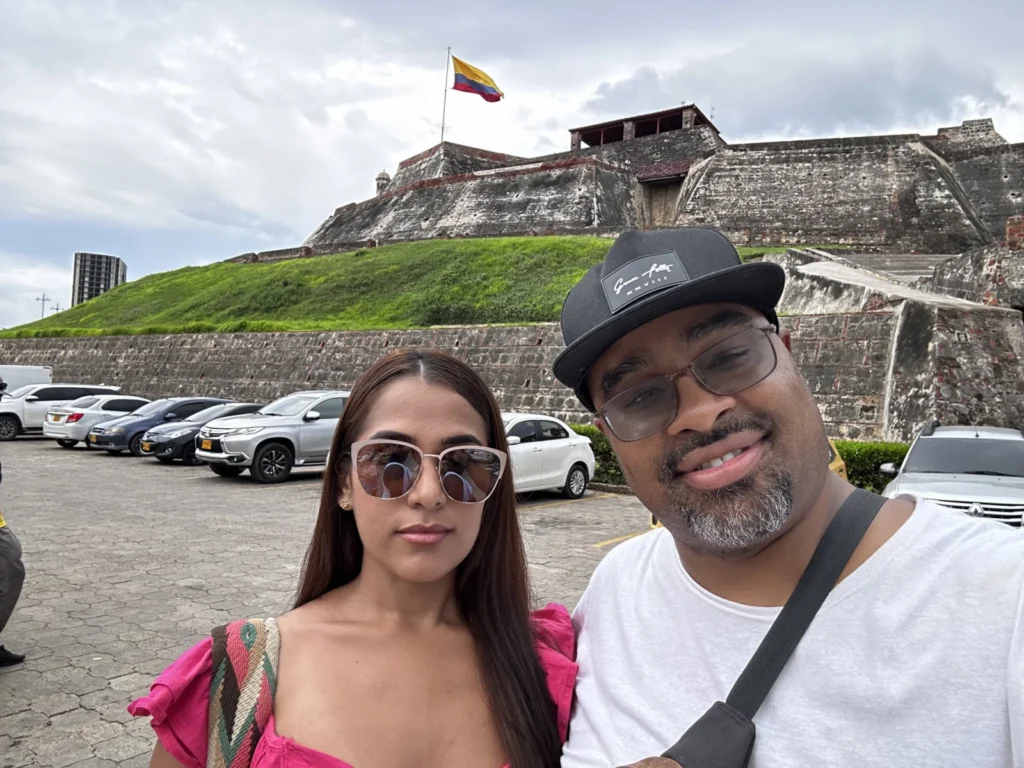
I’ll be straight with you: I have never been inside Castillo San Felipe de Barajas. I’ve seen it from the outside, several times, and that’s it.
The first time, on that taxi tour before the airport, I didn’t have time, and I said on camera “I’m kind of sad that I don’t get to walk it up.” Another time I came at night with a local friend, and it was closed: a guard confirmed that at night you can only take photos from outside, and visits are during the day. And in 2024, staying in Bocagrande with friends, we said “now we’ll probably climb it.” We didn’t. So it’s still on my list.
What I did see: the square in front with Los Zapatos Viejos, the monument of the old shoes. A taxi driver told me it’s for a poet who loved Cartagena more than his old shoes.
What others report about the inside: it’s described as the largest Spanish colonial fortification in the Americas, started in 1536 according to many guides and expanded over the centuries, on a hill over the city. Visitors say the underground tunnels are the highlight, designed so sound echoes through the corridors so no enemy could sneak in. Entry is listed around 45,000 COP (about $10 USD, as of 2026, check before you go), and people plan about 1.5 hours. Bring water and sunscreen, there’s almost no shade, and go early morning or late afternoon.
From Bocagrande it’s about 20 to 30 minutes on foot, or a quick Uber.
6. Eat Seafood Across From the Castillo
Right across from the Castillo there’s a seafood spot where it seems like everybody goes, and I ate there. I don’t have the name for you yet, so I’ll just call it a seafood spot across from the Castillo, and you’ll recognize the busy one.
The night I came with my local friend and the fort was closed, we asked the guard for a good restaurant nearby, and he pointed to one close by that was open. We ordered a picada, chicharrones with patacón, an extra portion of patacones (of course), and a jugo de corozo. The waiter also offered mora, strawberry and lulo, but no sangría. Somebody at the table said the suero costeño was “fake,” because the real one only comes from Montería. I’m not going to argue with that.
Patacones are where I’m useful, because plantain is my favorite food in life. I’d trade meat for plantain. The Colombian patacón is the cousin of the Haitian bannann peze: same idea, green plantain, smashed and fried. In Haiti it’s spicier, and we serve it with pikliz. Here it comes plainer, so I eat more of it.
What’s less fun: no prices on my side. Nobody filmed the bill that night, so I won’t guess. Agree on prices before you order, especially in tourist zones.
7. Spend a Night on the Rosario Islands
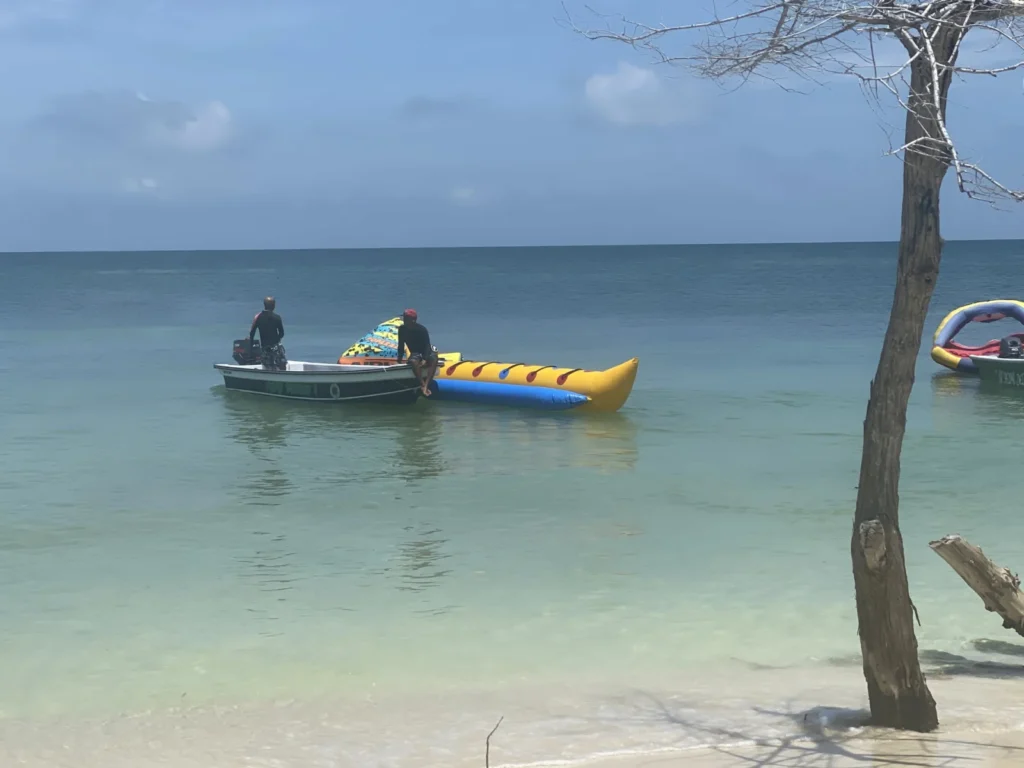
The Rosario Islands on my first trip, 2021.
I went to the Rosario Islands on my first trip and I loved it. It didn’t start well: we had to be at the airport around four in the morning for a flight around 5:30, missed it, spent about four extra hours at the airport, connected through Cali, and got to Cartagena around five in the afternoon. That’s part of having fun on vacation, right?
Then we took a boat with a pilot from Panama who had lived in Cartagena for 25 years because his wife is from there. As I remember it, the ride was two or three hours, longer than the roughly 45 minutes most tours quote, so we probably made stops. His advice: go early, the sea is calm in the morning and the waves come later.
We spent the night on a quiet island. We paid about 100 USD for the night, and we were basically alone. Food was okay, but the music was great. On the beach they offered coconut rice and patacón.
What’s less fun: guys coming at you to sell things and rip you off, and at the end they tried to overcharge us. Friends checked the bill and got it fixed. Agree on the price first, and make sure what’s on the bill is what you asked for.
The whole weekend is on my channel:
For a Rosario Islands day trip, shared tours run between 80,000 and 150,000 COP ($18-35 USD, as of 2026), private charters cost a lot more, and since the islands are part of a national park there’s a small entrance fee on top. The archipelago has about 28 small islands. Quality varies a lot between tours. They’re among the best places to visit in Colombia if you love beach days.
8. Take the Boat to Playa Blanca (Barú)
Caribbean Beaches Without the Resort Price Tag
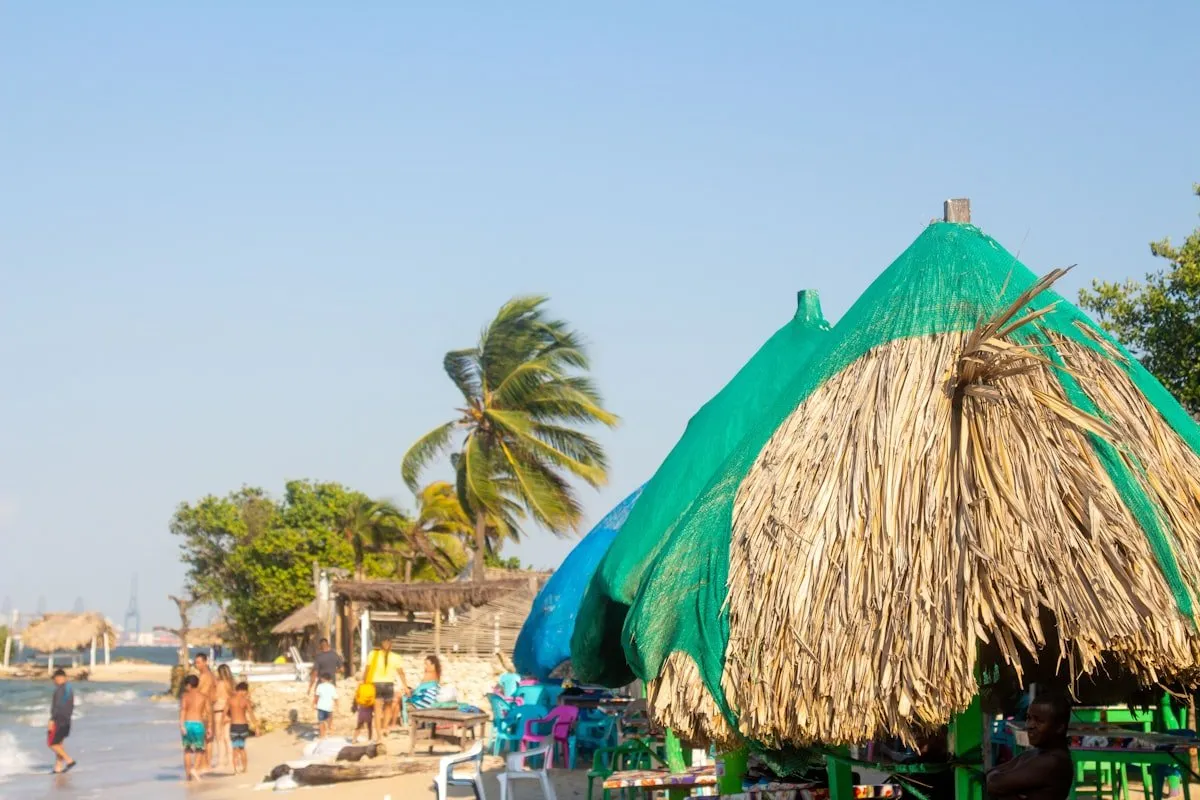
Playa Blanca on Barú. Bring cash and your own snacks if you want to save money.
I went to Playa Blanca Barú on my first trip too. Then, on a later trip in 2024, a taxi driver offered to take us to Barú, and I said no, because that day I didn’t want a boat, I wanted to ride in the car. It’s a shame, really. Funny thing: Barú is technically a peninsula connected by road, not an island, so the car option exists.
Playa Blanca is the closest postcard beach to Cartagena. You can get there by boat (about 45 minutes) or by road (about 1 hour). Expect vendors constantly selling massages, jewelry and food. A polite but firm “no, gracias” works.
Bring cash, because there are no ATMs. Sunbeds and umbrellas run about 20,000-30,000 COP, and seafood lunch plates (fried fish, coconut rice, patacones) around 25,000-35,000 COP, as of 2026. Check before you go.
9. Bocagrande: Go, But Know What You’re Getting
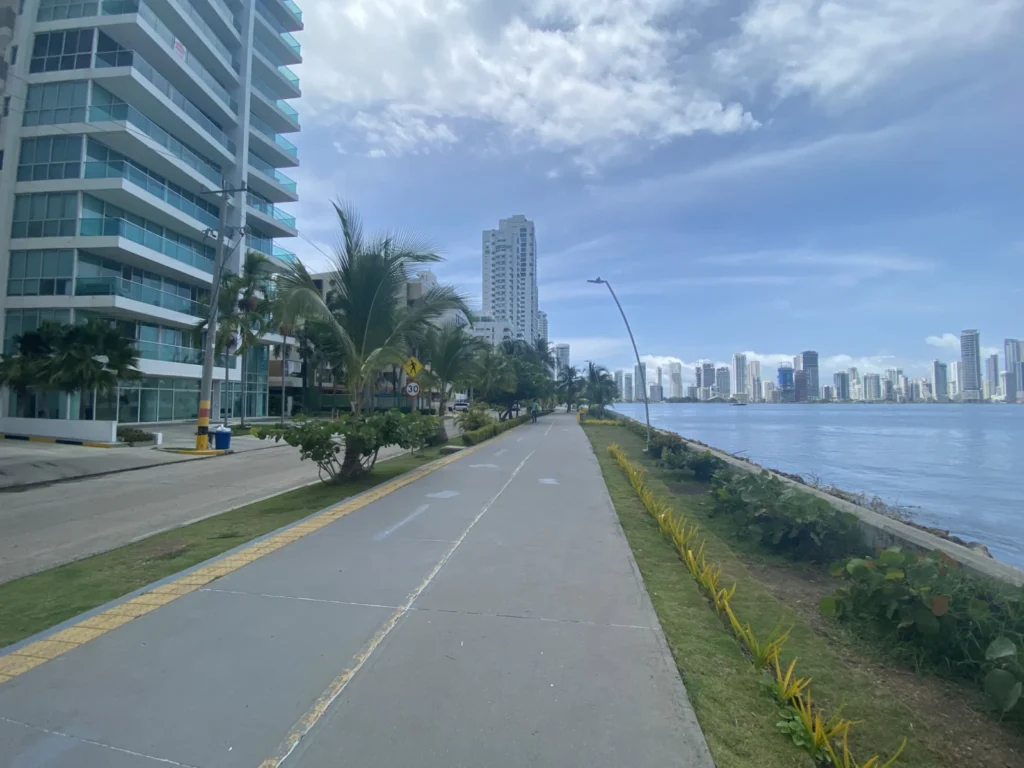
The Bocagrande waterfront, 2021.
So in 2024, hometown friends came to visit and we stayed in Bocagrande. My verdict, filmed on the spot: obviously it’s not good looking, it’s not great. The tide comes up noticeably from one day to the next, we were looking for a way to pass, and the water was cold, when the day before it was so hot we wanted to stay in it. I went in anyway, because the guys were there. I might as well go. At one point I even said “there’s nothing to do here.”
You can watch the whole day on my channel:
But Bocagrande Cartagena still has its uses. It’s the modern side, hotels and towers, tours leave from around there, and the Castillo is 20 to 30 minutes on foot or a short Uber. There’s also a mall with a view of the sea, right there in Bocagrande. In Montreal, that’s where we’d put a parking lot.
As a Bocagrande beach day, though, I’d keep my expectations low. For a real beach, go to Playa Blanca or the Rosario Islands.
10. Eat and Drink Like the Coast: Street Food and a Costeñita
The Real Flavors of Cartagena
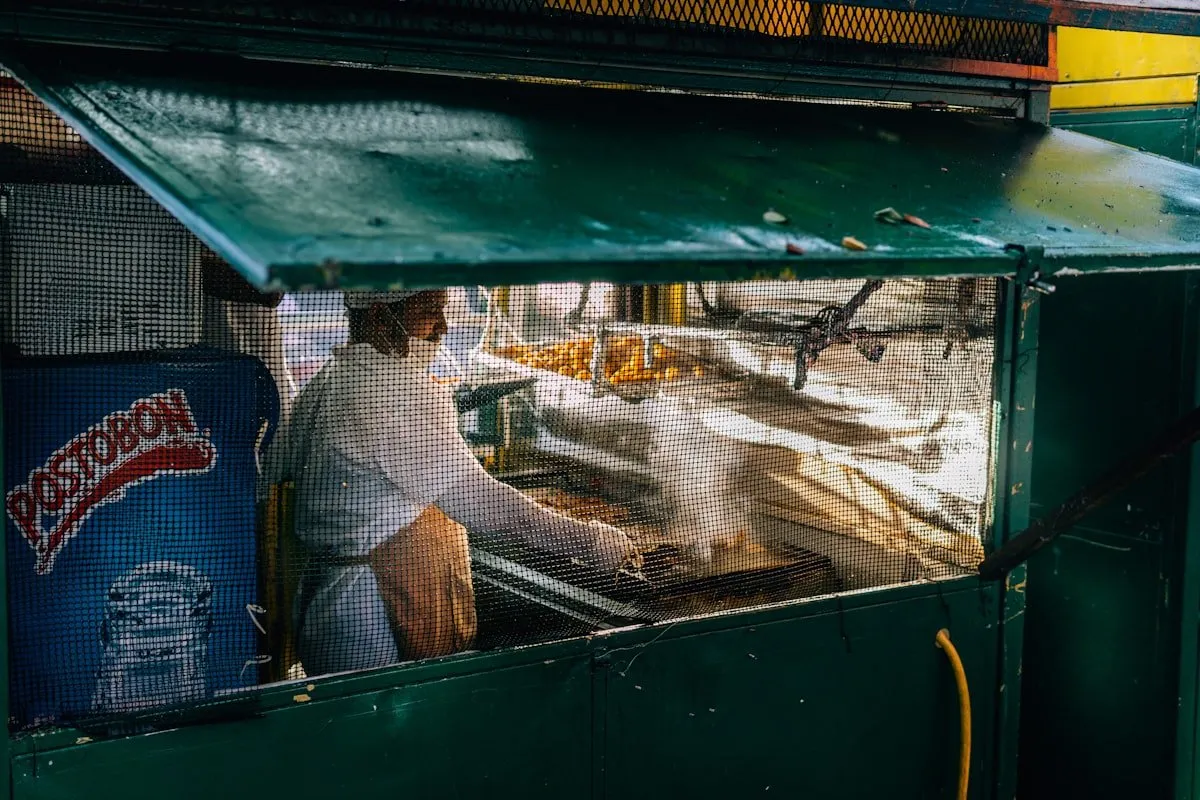
Arepas de huevo straight from the fryer, a Cartagena street classic.
Cartagena street food is among the best in Colombia. Here’s what to try, prices as of 2026:
- Arepas de huevo: Fried corn dough stuffed with egg, the classic Cartagena street food. About 3,000-5,000 COP.
- Empanadas: Crispy fried pockets with meat or cheese. Around 2,000-3,000 COP each.
- Ceviche: Street vendors in the Walled City sell cups of shrimp ceviche for about 10,000 COP.
- Cocadas: Coconut candy in different flavors, sold by Palenquera women carrying bowls on their heads.
- Jugo de corozo: A tart red juice from a local fruit. I had it across from the Castillo, and it works in the heat.
What I actually lived: one day walking around with a very heavy bag, we found fruit vendors with mangoes, and I had no cash on me. “Later, because now I don’t have money.” We ended up looking for a Davivienda ATM. Lesson: carry small cash for the street.
Another night we stopped at a tienda for a Costeñita, a smaller beer you only find on the coast. My friend said it finishes very quickly, and that the Costeña you get in Bogotá doesn’t taste the same. In a restaurant in the old town in 2021, the waiter said: “I only have at this moment Club Colombia, Stella and Heineken.” I took a Club Colombia. I also asked for an Irish coffee. No Irish coffee. And we got a dessert for two that came with melted cheese, which confused me more than I expected.
For more dishes, check out our complete guide to Colombian food.
11. Tour the City by Taxi (and Agree on the Price First)
Here’s something I noticed every time: when you ask a Cartagena taxi driver what to see, you get the same circuit. Castillo San Felipe, La Popa, El Centro, and Barú, which means a boat. In 2024 I said no to Barú because I wanted to stay in the car.
The taxi tour I did film was before my flight out: the port, the Castillo from outside, Los Zapatos Viejos, then La Popa, then lunch in Getsemaní. The driver explained a lot along the way, and I translated for the camera as best as I could, because my Spanish was really bad. Before that, a woman had offered me a tour for 75,000 COP and then never answered my text, so that’s not a price I can vouch for.
What’s less fun: the driver will try to pull a fast one. Negotiate before you get in, not at the end. From Bocagrande to the Castillo, we talked about just taking an Uber instead of the guy approaching us. Uber Cartagena rides are an option, and InDriver and DiDi are also popular in Colombia. I don’t have a fixed fare to give you: agree on it first.
12. Catch a Neighborhood Picó Party (Champeta)
One night, driving around with my local friend, we heard music from a neighborhood party. She explained what a picó is: huge sound systems that have their own names, like “el monstruo.” The parties around them are popular street parties where they only play champeta, with dance competitions.
I want to be clear: I watched and listened from outside, I didn’t dance and I didn’t join. Champeta is Afro-Colombian music born on the Caribbean coast, Cartagena and its neighborhoods included, and the picó culture is a big part of it.
What’s less fun: these are local parties at night, outside the tourist zone. If you go, go with a local who knows the area, keep your phone and valuables close, and take a car back.
That same night a street vendor came up to me: “Mi color! Where you from?” “Canada.” “Welcome.”
What I Haven’t Done Yet (But Others Recommend)
Everything below, I haven’t done. These are things to do in Cartagena Colombia that other travelers and guides recommend, with prices reported as of 2026. Check before you go.
Café Havana (Salsa)
Café Havana Cartagena is a salsa institution in Getsemaní, where live salsa bands play most nights and the floor fills with locals and travelers. Visitors report a cover charge of about 60,000 COP and drinks pricier than average. If it’s too crowded or expensive, people suggest walking Getsemaní and following the music: smaller bars on Calle de la Media Luna often have live music with no cover. Watch the bill.
Colombian Coffee Tasting
Several spots offer coffee tasting Cartagena-style, explaining the process from bean to cup. A guided tasting reportedly costs 60,000-100,000 COP and lasts about an hour, covering roast profiles and brewing methods. It’s indoors, so it works any season. For more, read our guide to Colombian coffee.
Chocolate Workshop or Rum and Chocolate Tasting
Two formats are offered in the Walled City. In a chocolate workshop, Cartagena shops have you make your own bar from raw cacao, about 90 minutes for around 80,000-120,000 COP. For a rum tasting, Cartagena bars pair local rums with chocolate, about an hour for around 80,000-120,000 COP, and people leave knowing the difference between aged Colombian rums and what to order at bars.
Palace of the Inquisition
The Palace of the Inquisition Cartagena has on Plaza de Bolívar documents the Inquisition’s presence from 1610 to 1821. The building is one of the finest examples of colonial architecture in the city, and the displays include original torture devices. Entry is reported at about 24,000 COP; plan 45 minutes to an hour. Not for everyone.
Sunset Boat Cruise
A sunset cruise Cartagena operators run shows the skyline from the water at golden hour. Cruises last about 2 hours, most include drinks and sometimes dinner, and prices range from 100,000 to 300,000 COP depending on the boat and what’s included. Compare what’s actually included before paying.
The Door Knockers of the Old City
The Cartagena door knockers are ornate bronze knockers on the colonial doors. Locals say each one had a meaning: a lion for a military leader, a lizard for royalty, a mermaid for a sailor, an owl for a teacher or scholar, a hand for a priest. Treat that as tradition, not proven fact. Look on Calle del Curato, Calle de la Iglesia, and around Plaza de San Diego. Free.
Naval Museum
The Naval Museum Cartagena visitors describe is one of the biggest in the city, full of Colombian Navy history, old maps and ship models. Many people expect a quick visit and stay longer than planned. Entry is reported at about 25,000 COP.
Modern Art Museum (MAMC)
The Museo de Arte Moderno Cartagena shows Latin American contemporary art in a converted colonial building, with a rotating collection. Entry is reported at 10,000 COP. People use it as a place to escape the midday heat for an hour.
Manga
Manga Cartagena is the neighborhood most tourists never see, on a small peninsula south of Getsemaní, with early 20th-century Republican-era mansions. The streets are quiet and almost empty of visitors. It’s described as a 15-minute walk from Getsemaní. Go in daylight.
Free Walking Tour
Several companies run a free walking tour Cartagena-wide through the Walled City and Getsemaní. Tours last about 2.5 hours and cover history, architecture and culture. Guides work on tips, so bring cash. Travelers say it’s the best way to get oriented on your first day.
La Serrezuela
La Serrezuela is a historic bullfighting ring turned into a high-end shopping center. It’s air-conditioned, and visitors take the escalator to the top floor, where the original wooden arena has been preserved. Free to enter. Note: this is not the sea-view mall I mentioned in Bocagrande.
San Pedro Claver Church and Museum
San Pedro Claver Church and its monastery are dedicated to Saint Peter Claver, a Spanish Jesuit priest who spent his life ministering to enslaved Africans brought through Cartagena’s port. The museum includes his original quarters and artifacts, and the courtyard is calm. Entry is reported at about 17,000 COP.
Caribbean Cooking Class
A cooking class Cartagena-style usually starts with a market trip to buy ingredients, then hands-on cooking: coconut rice, fried fish, patacones and ceviche. Half-day classes run about 150,000-250,000 COP. If I take one, it’ll be for the patacones.
Bazurto Market
Bazurto Market is Cartagena’s main local market and the opposite of the polished tourist experience: loud, chaotic, colorful, with fruit, fish, meat, herbs and household goods in every aisle. Watch your belongings, and go in the morning.
The Palenquera Women
The Palenqueras Cartagena is known for are descendants of escaped enslaved Africans from San Basilio de Palenque, often described as the first free town in the Americas; UNESCO lists its cultural space as intangible cultural heritage. They wear bright traditional dresses and carry fruit bowls on their heads. Ask before a photo and offer a tip (5,000-10,000 COP).
Chiva Bus Party
A chiva bus Cartagena party is a colorful open-air bus that drives through the city at night with music, drinks and dancing on board. Prices start around 60,000 COP. Not exactly a cultural deep-dive, but people say it’s fun if you’re in the mood.
Free Things to Do in Cartagena
Cartagena doesn’t have to be expensive. Here are the best free things to do in Cartagena:
- Walk the city walls at sunset (free access from several entry points)
- Find the cuevas in the walls, the small rooms where cannons fired toward the sea
- Watch the white-clothes custom at night in El Centro (it’s the heat, not history)
- Explore Getsemaní’s street art on a self-guided mural tour
- Visit Plaza de Bolívar and people-watch in the shade of the trees
- See the India Catalina statue near the Convention Center
- Browse La Serrezuela and its preserved bullfighting arena on the top floor
- Watch the Palenquera women in traditional dress (photos cost a small tip)
- Walk through Manga to see the Republican-era mansions
- Take a free walking tour (tips-based)
Cartagena Neighborhood Guide: Where to Stay
Knowing the neighborhoods helps you decide where to stay in Cartagena and what kind of trip you want.
| Neighborhood | Vibe | Best For | Budget Level |
|---|---|---|---|
| Walled City (Centro Historico) | Historic, tourist-heavy, beautiful | First-time visitors, architecture lovers | $$$ |
| Getsemani | Artsy, lively, authentic | Budget travelers, nightlife, street art | $$ |
| Bocagrande | Modern, beachy, commercial | Beach access, chain hotels, shopping | $$-$$$ |
| Manga | Quiet, residential, historic | Off-the-beaten-path, photography | $$ |
Where I’ve actually stayed:
- El Centro: my first trips, at a corner near Avenida Santo Domingo. You walk everywhere, the walls are right there, and at night you’re in the middle of it. The trade-off is vendors and noise.
- Bocagrande: the 2024 trip with friends. Practical for the Castillo (20 to 30 minutes on foot or an Uber) and for the mall, but the beach was disappointing.
If it’s your first time, I’d stay in El Centro or Getsemaní and visit Bocagrande, not the other way around.
For accommodation options across Colombia, see our guide to the best hotels in Colombia.
What to Skip in Cartagena (Tourist Traps)
If you’re wondering what not to do in Cartagena, here’s what I’d avoid or think twice about:
- Horse-drawn carriages: The horses often look exhausted and dehydrated in the Caribbean heat. Walk instead.
- The Mud Volcano (Volcán del Totumo): I’ve never been, so this is what other travelers report: a long drive for a cramped, lukewarm mud bath, an aggressive “massage” inside, and basic showers. Many say it’s mostly for the photo.
- Overpriced restaurants on Plaza Santo Domingo: The location is beautiful, but prices are reported at 2-3x higher than restaurants one block away. Walk a street or two.
- Bocagrande beach: The sand is grey, the water can be murky, and vendors are everywhere. I lived it (see number 9). For a real beach day, go to Playa Blanca or the Rosario Islands.
- Saying “no” once and expecting it to work: Vendors can keep insisting after a no. Keep walking, stay polite, don’t stop to explain.
- Getting in a taxi without a price: Agree first, every time (see number 11).
How Much Does Cartagena Cost? Daily Budget (in USD and CAD)
Cartagena is one of the more expensive cities in Colombia, but still affordable by North American or European standards. Here’s what a typical day costs per person, in 2026:
| Category | Budget | Mid-Range | Comfort |
|---|---|---|---|
| Accommodation | 40,000-80,000 COP ($9-18) | 150,000-300,000 COP ($35-70) | 400,000+ COP ($90+) |
| Food | 30,000-50,000 COP ($7-12) | 60,000-100,000 COP ($14-23) | 120,000+ COP ($28+) |
| Transport | 10,000-20,000 COP ($2-5) | 20,000-40,000 COP ($5-9) | 50,000+ COP ($12+) |
| Activities | 0-30,000 COP ($0-7) | 50,000-100,000 COP ($12-23) | 150,000+ COP ($35+) |
| Daily Total | $18-42 USD | $66-125 USD | $165+ USD |
The USD conversions depend on the exchange rate of the day, so check the current rate before you budget.
Now the Cartagena budget from a Canadian wallet, because this is where five years of trips show. In 2021, 1 CAD got me about 3,100 to 3,300 COP. In 2026, it’s around 2,100. The peso got stronger, so the same 150,000 COP room that cost me under 50 CAD back then is now roughly 70 CAD. Colombia is still affordable, but for long stays it’s clearly less of a deal than when I first came. Cartagena cost-wise, plan on the higher end in the Walled City, and keep cash for the street and the beaches.
For a full rundown of travel costs across the country, read our Ultimate Colombia Travel Guide.
Cartagena from a Cruise Ship: What Fits in a Port Day
A lot of people searching Cartagena cruise port things to do only have a few hours. Here’s what realistically fits, based on what’s covered above:
- The Walled City (number 1): the priority. Most passengers take a taxi or a ship excursion to the old town.
- A walk on the walls (number 2): right next to the old town, free, and fits easily.
- Castillo San Felipe (number 5): close to the old town. Seeing it from outside takes minutes; visitors plan about 1.5 hours to go inside.
- Street food (number 10): arepas de huevo and juice, cheap and fast.
What won’t fit well: the Rosario Islands or Playa Blanca, unless it’s an excursion organized by your ship, because boat schedules and the sea don’t care about your all-aboard time.
The point of vigilance: taxis and vendors know the cruise schedule. Agree on the fare before getting in, carry small cash, and leave yourself a big margin to get back. I don’t have a fixed fare or distance to give you: confirm with your cruise line.
3-Day Cartagena Itinerary
Here’s a 3 day Cartagena itinerary built around the 12 things I’ve done, with the others as options.
Day 1: The Walled City and Getsemaní
Morning: Start early (before 9 AM) and explore the Walled City (number 1). Walk through Plaza de Bolívar and wander the colorful streets of the San Diego neighborhood. Stop for coffee at a local café. Optional: the Inquisition Palace.
Afternoon: Cross into Getsemaní for lunch at a local restaurant (number 3). Explore the street art. Walk through Parque Centenario. Optional: La Serrezuela for air conditioning and a cold drink.
Evening: Watch the sunset from the city walls near Café del Mar (number 2). Dinner in the Walled City, then back to Getsemaní for the street shows and live music. Optional: Café Havana.
Day 2: Castillo San Felipe and Islands
Morning: If you stay in Bocagrande (number 9), walk 20 to 30 minutes or take an Uber to Castillo San Felipe de Barajas (number 5). It reportedly opens at 8 AM (check before you go); visitors spend 1.5-2 hours inside with the tunnels. Then eat at the seafood spot across from the Castillo (number 6).
Afternoon: Take a boat to the Rosario Islands (number 7) or Playa Blanca (number 8) for the rest of the day. Most tours return around 4-5 PM. Better yet, do what I did and spend the night on an island.
Evening: Dinner in Getsemaní. Try the street food along Calle de la Media Luna (number 10).
Day 3: La Popa and Local Life
Morning: Taxi tour with the price agreed first (number 11), up to La Popa and its money museum (number 4). Optional: coffee or chocolate tasting, a cooking class, or San Pedro Claver Church.
Afternoon: Optional: walk through Manga to see the Republican-era houses, visit the Naval Museum or the Modern Art Museum, browse the shops around Plaza de San Diego.
Evening: Final sunset from the walls. Splurge on a nice dinner, or keep it casual with arepas de huevo and ceviche from street vendors. If you’re with a local, listen for a picó (number 12). Optional: a chiva bus.
Safety Tips for Cartagena
Is Cartagena safe? It’s generally safe for tourists, but common-sense precautions apply:
- Don’t flash expensive jewelry or electronics in crowded areas, especially at night
- Use registered taxis or ride apps (InDriver and DiDi are popular in Colombia) rather than hailing random cabs
- Watch for common scams: “free” bracelets that turn into demands for payment, unsolicited massages on the beach, and overcharging in non-metered taxis
- Avoid walking alone at night outside the Walled City and Getsemaní, especially toward the port area and La Matuna
- Keep copies of your passport in your phone and hotel safe
- Stay hydrated: The heat and humidity catch people off guard. Carry water and take breaks in shade or air conditioning
From my side: the two things that actually happened to me were vendors who don’t take no for an answer and bills that come back higher than agreed (Rosario). Nobody threatened me. Coming from Canada, the difference is the pressure to buy, not danger. Agree on prices first, and check the bill.
For a detailed look at safety across the country, read our article on whether Colombia is dangerous for travelers. If you’re traveling alone, our solo traveler’s guide to Colombia covers specific tips.
Best Time to Visit Cartagena
Cartagena is hot and humid year-round. Temperatures hover between 28-32 C (82-90 F) every month, according to standard climate data. The main difference is rain.
- Dry season (December to April): Best weather, fewer mosquitoes, but peak tourist season with higher prices and bigger crowds. January and February are the busiest months.
- Shoulder season (May, November): Occasional rain but fewer tourists and lower prices. A good compromise, and if you’re looking at Cartagena in November, that’s what you’ll get.
- Rainy season (June to October): Heavy afternoon showers most days, but mornings are usually clear. Prices drop significantly, and you’ll have attractions more to yourself.
Whatever the season, the sea for the islands is calmer early in the morning. Our pilot told us that on the way to Rosario.
We wrote a full breakdown in our guide to the best time to visit Cartagena.
Frequently Asked Questions
Is Cartagena a good place to visit?
Yes. Is Cartagena worth visiting? I’ve gone back at least four times. It has the fort, the historic center, Getsemaní, La Popa, and islands around to breathe. The one downside for me is the vendors’ insistence.
Are American tourists welcome in Colombia?
Yes, North Americans are very welcome. One detail the US-focused guides skip: as a Canadian, I pay an entry fee that Americans don’t mention. Check the current amount and rules with Colombia’s official migration authorities before you fly.
What to do in and around Cartagena, Colombia?
In town: the Walled City, the walls, Getsemaní, La Popa, Castillo San Felipe. Around it: the Rosario Islands and Playa Blanca on Barú.
What should you not do in Cartagena?
Don’t get in a taxi without agreeing on the price, don’t accept a “free” bracelet, don’t pay a beach bill without checking it, and don’t plan a full beach day in Bocagrande.
How many days do you need in Cartagena?
Three to four days is ideal. That gives you time for the Walled City, a fortress, a day trip to the islands, and the nightlife without rushing. If you want to add a mud volcano trip or nearby towns, plan for five days.
Is Cartagena expensive compared to other Colombian cities?
Yes, Cartagena is one of the pricier cities in Colombia, especially in the Walled City. But it’s still affordable by international standards. Budget travelers can get by on $25-40 USD per day. Stay in Getsemaní and eat at local spots to keep costs down.
Is Cartagena safe for solo travelers?
Cartagena is generally safe for solo travelers, including women traveling alone. Stick to well-lit, busy areas at night, use ride apps instead of street taxis, and be aware of common scams. The Walled City and Getsemaní are the safest areas for walking at night.
Can you drink the tap water in Cartagena?
It’s not recommended. Stick to bottled or filtered water. Most restaurants and hotels provide purified water. A reusable bottle with a filter is a smart investment for Colombia travel in general.
Do you need to speak Spanish in Cartagena?
Not necessarily. Cartagena is one of the most tourist-friendly cities in Colombia, and many people in hospitality speak basic English. I arrived without Spanish and got by, but learning a few phrases makes everything easier, and locals appreciate the effort.
What should I pack for Cartagena?
Light, breathable clothing is essential, the humidity is intense. Pack sunscreen (SPF 50+), a reusable water bottle, comfortable walking shoes, a light rain jacket (even in dry season), and mosquito repellent. Leave the jeans at home. A white shirt will fit right in at night.
Why do people wear white in Cartagena at night?
A local explained it to me: it’s the climate. White is comfortable in the heat, a white shirt replaces the jacket and tie, and families from Medellín come dressed in white. No historical meaning.
What can you do in Cartagena on a cruise stop?
The Walled City, a walk on the walls, Castillo San Felipe and some street food fit in a port day. Skip the islands unless your ship organizes the excursion.
Final Thoughts
I’ve been to Cartagena at least four times and the Castillo is still on my list, along with half of the section above. That’s fine. Next time I’m going early in the morning, with no rain, and I’m climbing it.
Planning a bigger trip? Check out our guide to 10 cities in Colombia for first-time travelers and our 12 coastal towns in Colombia for more ideas.