Rules checked against Cancillería and Migración Colombia, October 2026. This is general information, not legal advice: immigration rules change, and the Colombian consulate or Cancillería has the final word on your case.
The Colombia digital nomad visa is a real, working program: a Type V visa called “Nómada Digital”, created by Cancillería’s Resolución 5477 of 2022, that lets remote workers paid from abroad live in Colombia for up to two years. That part of the story is well covered. What most guides skip is the step before it: a lot of remote workers already have a legal way to spend up to 180 days a year in Colombia without any visa at all, and for some of them the visa is a cost they don’t need.
So this guide starts with the 90/180-day visitor rule, then covers the visa itself: the 2026 income threshold, documents, the six application steps, fees, taxes, cost of living and cities. It also covers two things the top results leave out: the entry fee Canadians pay, and the spouse visa, the one that actually starts a residency clock. Every amount carries its official source and date; where something couldn’t be confirmed, the text says so: check with Cancillería before applying.
The author is Canadian, has never applied for a Colombian visa, and is at the point of choosing one, which is why two short first-person boxes appear further down. If Colombia is still at the idea stage, start with the guide to planning your trip to Colombia.
Do You Even Need a Visa? The 90/180-Day Rule
Before paying for anything, it’s worth reading the paragraph that Resolución 5477 of 2022 itself writes about digital nomads who come from visa-exempt countries. In the article on the digital nomad visa (article 46, parágrafo, as published in Cancillería’s Normograma), the resolution says that digital nomads, remote workers and digital entrepreneurs whose nationality is exempt from short-stay visas:
“podrán ingresar sin visa y permanecer en Colombia con Permiso de Ingreso otorgado por la autoridad migratoria”
In English: they “may enter without a visa and remain in Colombia with an Entry Permit granted by the migration authority.” The same paragraph sets two limits. The stay cannot generate payments from Colombian companies, and it cannot exceed 90 days, extendable up to 180 days, continuous or not, per calendar year.
Put plainly, a remote worker from a visa-exempt country who is paid by a foreign employer or foreign clients can work from a laptop in Colombia on the entry permit stamped at the airport, no visa needed. That is the official position in the resolution, not a gray area.
The count is per calendar year, so it resets on January 1. A person who used 180 days between July and December can, in principle, start a new 90-day period in January, although the border officer still decides at each entry how many days to grant.
Can I live in Colombia as a US citizen? Yes, up to 180 days per calendar year without a visa, as long as no Colombian company pays you. Beyond 180 days in the same year, you need a visa. Americans and Canadians are both on the visa-exempt list today, but the list changes: check the “eligible countries” page on Cancillería’s site rather than any blog copy of it, this one included.
The extension from 90 to 180 days is called a prórroga de permanencia. It’s requested from Migración Colombia before the first 90 days run out. Its official fee is in the cost section below.
For a digital nomad in Colombia, the test is simple: six months or less per year, the visitor permit may already cover it; past 180 days, the visa starts to make sense.
What Is the Colombia Digital Nomad Visa (Visa V)?
The Colombia digital nomad visa, officially “Visa V – Nómada Digital”, is set out in article 46 of Resolución 5477 of 2022. The resolution is dated July 22, 2022 (published in the Diario Oficial No. 52.103 that day) and took effect 90 days later, on October 21, 2022, according to the text in Cancillería’s Normograma. That’s why many sites date the visa to October 2022: the program started then, but the rule itself is from July. Colombia was one of the first countries in Latin America to set up a structured digital nomad visa.
Three things define it:
- It’s a visitor visa (Type V), not a resident visa. That’s what makes it lighter to obtain than migrant (M) or resident (R) visas.
- It lasts up to two years. The resolution says: “Vigencia: Hasta por dos (2) años.”
- The money has to come from outside Colombia. You can work for a foreign employer, run your own business registered abroad, or serve foreign clients as a freelancer.
The restriction is spelled out in the resolution: the visa “no permite trabajar o desarrollar actividad remunerada con persona jurídica o natural domiciliada en el territorio nacional”, which means it does not allow working or carrying out paid activity with any company or person domiciled in Colombia. A Colombian client, a Colombian employer, or a Colombian payroll is outside what this visa covers.
The original version of this article said the visa is “renewable, you can apply again.” That needs care. A Colombian visa generally isn’t extended like a library loan: when it expires, you file a new application. Whether a second nomad visa is granted to someone who just finished two years on one is decided case by case. Check with Cancillería before applying, and don’t build a four-year plan on the assumption that the second one is automatic.
One more thing that matters for anyone thinking long-term: time on the digital nomad visa does not count toward residency. The table in the spouse section shows which visas do.
Requirements & Eligibility
The colombia digital nomad visa requirements come from article 46 of Resolución 5477 of 2022. The first one is about nationality: you must hold a passport from a country exempt from short-stay visas. Those are the same eligible countries as in the 90/180-day rule above, and the list lives on Cancillería’s site.
Income Requirements
The colombia digital nomad visa income requirements are set in minimum wages, not in dollars. You need to show income equivalent to three (3) SMMLV (salarios mínimos mensuales legales vigentes, Colombia’s legal monthly minimum wage) during the last three months.
For 2026, the minimum wage is 1,750,905 COP. It was set by Decreto 1469 of December 29, 2025, a 23% increase over 2025’s 1,423,500 COP. The Consejo de Estado suspended that decree provisionally in February 2026, and the government issued Decreto 159 of February 19, 2026, which keeps the same amount on a provisional basis. Press reports since then (Portafolio) say the figure still stands at 1,750,905 COP, but the legal situation has moved several times this year, so confirm it before you apply.
Three times 1,750,905 COP is 5,252,715 COP per month.
The original version of this article put the threshold at “roughly $1,050 USD/month.” That’s wrong for 2026. At the official exchange rate (TRM) of early October 2026, which Portafolio and Noticias Caracol reported between about 3,200 and 3,310 COP per US dollar, 5,252,715 COP comes to roughly 1,590 to 1,640 USD per month. The peso moves, so redo the math with the TRM published by the Superintendencia Financiera on the day you apply.
The three-month window is what Cancillería looks at. The point is consistent, recent income, not a one-off payment, a projection or a promise. Bank statements showing regular deposits work well. So does an employment contract that states the salary. Freelancers can pair client invoices with the bank statements showing those payments landing. If income varies from month to month, make sure the documents show the average clearly clearing the bar.
The income just needs to come from a foreign source. Someone earning 2,000 USD a month from clients in the US, Canada or Europe would be above the 2026 threshold at October rates, but not by a wide margin, which is a change from 2022.
Documents You’ll Need
According to Resolución 5477 of 2022, the file includes:
- A passport from a visa-exempt country
- A letter from the foreign company or companies you work for, in Spanish or English, or proof that you own the foreign business you run
- For entrepreneurs, a letter explaining the business (the motivation letter)
- Bank statements proving the income for the last three months
- A health insurance policy covering accident, illness, maternity, disability, hospitalization, death and repatriation
The original version of this article also listed the items below. They’re common in visa applications, but they couldn’t be confirmed against the official text, so check them with Cancillería before applying:
- Passport valid for at least 6 months
- Passport-style photo, white background, 3×4 cm
- Health insurance valid in Colombia for the full duration of the visa
- Proof of income: bank statements from the last 3 months, employment contract, or client invoices
- Motivation letter explaining your remote work situation and why you want to live in Colombia
- Apostilled documents “if required”, which depends on the country that issued them (check with your consulate)
The motivation letter doesn’t need to be a literary piece. One page explaining who you work for, what you do, and that you intend to live in Colombia while continuing that remote work is enough. Factual and professional beats long.
Health Insurance
The insurance requirement isn’t optional. The policy has to cover the risks listed in the resolution (accident, illness, maternity, disability, hospitalization, death and repatriation) and has to be valid in Colombia. The original version of this article said it must cover the full length of the visa requested, so a two-year visa would need two years of coverage or a documented annual renewal. That’s the safe way to read it, and the one to confirm with Cancillería.
Both Colombian insurers and international plans can work, as long as Colombia is explicitly a covered country. SafetyWing’s Nomad Insurance is widely used by nomads applying for this visa: it runs month to month, and the original version of this article priced it at around 45 USD a month, roughly 540 USD a year. World Nomads is another option, usually a bit higher depending on age and home country. Both prices need to be checked against the insurers’ own pricing pages on the day you buy, since they depend on age, coverage and the date.
Whatever the plan, get a certificate or letter from the insurer confirming coverage in Colombia and the risks covered. The application asks for proof, not just a policy number.
How to Apply for the Colombia Digital Nomad Visa (Step-by-Step)
The colombia digital nomad visa application happens entirely online. The colombia digital nomad visa official website is Cancillería’s procedures portal: tramitesmre.cancilleria.gov.co. The six steps below follow the original version of this article. The practical details (menu names, file sizes, timers, delays) come from that version and from applicants’ reports, not from an official page, so treat them as a guide and check with Cancillería before applying.
Step 1 — Create Your Cancillería Account
Create an account on the portal and verify your email. The site is in Spanish. Chrome’s built-in translation is usually good enough to find your way around, but read the final summary carefully before submitting.
Step 2 — Fill Out the Online Application
Pick the visa type (the original version of this article describes the path as “Visa Tipo V” then “Nómada Digital”; confirm the current menu). The form covers personal information, passport details, planned dates and work situation. Keep your passport open: it asks for specific fields from the bio page. The original version also warns about an inactivity timer that logs you out, so try to fill it in one sitting.
Step 3 — Upload Documents
Scan everything as PDF. The original version of this article gave a limit of 5 MB per file and warned that oversized uploads can fail without an error message. Compress scans first, and check each upload confirmation before moving on.
Step 4 — Pay the Fee
Cancillería charges a study fee when you apply, and an issuance fee if the visa is approved. The amounts are in the cost section below. The study fee is generally not refunded if the visa is denied, so make sure the file is complete before paying.
Step 5 — Wait for the Decision
The colombia digital nomad visa processing time given in the original version of this article is up to 30 calendar days. That figure couldn’t be confirmed on an official page, and the “5 to 15 business days in practice” sometimes quoted online comes from applicants’ reports, not from Cancillería. Watch your email and the portal. If the visa is approved, download it right away and keep copies in more than one place: you’ll show it at the border.
Step 6 — Get Your Cédula de Extranjería
The visa isn’t the finish line. A visa valid for more than three months requires registering with Migración Colombia and applying for the cédula de extranjería, the foreign resident ID card. The original version of this article gave a deadline of 15 days after arrival; check the current deadline with Migración Colombia. The official fee is 294,000 COP according to Migración Colombia’s Resolución 0599 of February 10, 2026, replacing the “230,000 COP (~$55 USD)” quoted in the original version. At early October 2026 rates, that’s around 90 USD.
The cédula is the ID that local life runs on: a SIM card in your name, a bank account, a lease, sometimes even a gym. Migración Colombia offices in Bogotá and Medellín book up, so schedule early.
The Entry Fee Canadians Pay (and Americans Don’t)
This is the part none of the top five results mention, because they’re written for Americans. Colombia charges Canadian citizens a fee on entry. According to Migración Colombia’s Resolución 0599 of February 10, 2026, the amount is 270,000 COP (about 80 to 85 USD at early October 2026 rates).
Some background, to check with Migración Colombia before you fly: the charge was introduced on November 1, 2023 by Resolución 2676, then fixed in Canadian dollars by Resolución 1422 of 2024, before the 2026 resolution set the amount above in pesos. It’s widely described as a reciprocity measure, since Canada requires a visa from Colombians.
The exemptions listed are: children under 14, people over 79, holders of a valid Colombian visa, diplomats, crew members, and passengers in transit. Check the current list before travel.
That third exemption is the one that changes the math. A Canadian who comes in and out of Colombia several times a year pays the fee on each entry as a visitor. With a valid visa (digital nomad, spouse, or any other category), the fee goes away. For someone who enters three or four times a year, that’s a real part of the visa calculation, and it’s a part the American guides can’t see.
From Wid — why this section exists
So I travel on a Canadian passport, and I pay this fee every time I come into Colombia. Every single entry. And basically none of the English guides I read before my trips said a word about it, because they’re written for Americans, and Americans don’t pay it. I’ve never applied for a Colombian visa. I come in as a visitor and I live on my 90 days, and my last entry was on September 15, 2026. So when I look at the visa options, this fee is part of my math, not a footnote.
How Much Does the Colombia Digital Nomad Visa Cost?
So, how much is a digital nomad visa for Colombia? The honest answer in October 2026: some costs are confirmed by an official resolution, and some are not. The colombia digital nomad visa cost table below keeps the lines from the original version of this article, corrected, with a Source column.
| Item | Cost | Source |
|---|---|---|
| Visa study fee (paid when applying, non-refundable) | ~$52 USD | Original article; not confirmed on Cancillería’s fee schedule: check before applying |
| Visa issuance fee (if approved) | Not confirmed | Secondary sources disagree: check Cancillería’s fee schedule |
| Cédula de extranjería | 294,000 COP | Migración Colombia, Res. 0599 (Feb. 10, 2026) |
| Prórroga (90 → 180 days, visitors) | 150,000 COP | Migración Colombia, Res. 0599 (Feb. 10, 2026) |
| Entry fee, Canadian citizens (per entry, waived with a valid visa) | 270,000 COP | Migración Colombia, Res. 0599 (Feb. 10, 2026) |
| Health insurance (annual, SafetyWing) | ~$540–600 USD | Original article; check the insurer’s pricing page |
| Apostilles (if required, per document) | $20–50 USD | Original article; depends on the issuing country |
| Total first year | ~$670–760 USD | Original article; not confirmed, recalculate with official fees |
The “~$107 USD all-in” figure from the original version (study fee plus cédula) is not confirmed either: with the cédula now at 294,000 COP and the issuance fee unknown, it’s out of date. Don’t budget on a visa fee that Cancillería’s own fee schedule doesn’t show.
The original version also made an argument for the visa: the alternative, leaving Colombia to reset a visitor stay, means flights to Lima, Quito or Panama City at 150 to 300 USD round trip per exit. That’s an unsourced estimate, and it rests on a misunderstanding. The visitor limit is 180 days per calendar year, and leaving the country does not reset it. A border run doesn’t buy extra days in the same year. What the visa buys is the right to stay past 180 days, plus, for Canadians, the end of the entry fee on each trip.
Tourist Stamp vs. Digital Nomad Visa vs. Migrant Visa
This is the colombia digital nomad visa vs tourist visa question, with a third option most guides skip. Colombia gives remote workers three realistic paths, and picking the wrong one costs money, legal standing, or both. The table keeps the eight rows from the original version, with corrections noted.
| Feature | Tourist stamp (entry permit) | Digital Nomad Visa (V) | Migrant / Resident visa (M/R) |
|---|---|---|---|
| Duration | 90 days, extendable to 180 per calendar year | Up to 2 years | M: up to 3 years; R: indefinite (check with Cancillería) |
| Work legally? | Remote work for foreign payers only (Res. 5477, art. 46) | Yes, for foreign employers and clients | Depends on the category; some M visas give an open work permit |
| Cost | Free on entry for most visa-exempt countries (Canadians pay an entry fee) | Not confirmed (see cost section) | $200–400+ (original article; not confirmed) |
| Taxes | Not resident if under 183 days | Complex — see below | Same 183-day rule; residents are taxed on worldwide income |
| Counts toward residency? | No | No | Certain M visas, per article 90 (see below) |
| Can open bank account? | Difficult | Yes, with the cédula | Yes, with the cédula |
| Renewability | Resets on January 1 | New application at the end | New application or move to R |
| Best for | Short trips, testing the waters | 6–24 month stays | Long-term commitment |
Note that the last column was called “Cedula (M/R Visa)” in the original version. The cédula is the ID card, not a visa: holders of a V visa longer than three months get one too.
If you’re coming for less than six months in a year to see whether Colombia works for you, the visitor permit is usually enough. Most Western passports get 90 days on arrival, extendable to 180 days with a prórroga from Migración Colombia (150,000 COP, Res. 0599 of 2026). You can work remotely for foreign payers under Resolución 5477. The downsides: banking is a pain, and for Canadians the entry fee comes back each time.
The digital nomad visa is the sweet spot for people staying longer than 180 days in a year without a Colombian employer. You get up to two years and a cédula, the ID that unlocks a real bank account, a SIM card in your name and a dozen other practical things. The catch: it doesn’t count toward residency, and the 183-day tax rule still applies.
The M or R path is for people making a real commitment, or who qualify through a spouse, work, investment or a pension. It asks for more documents, and certain M visas are the only route that builds time toward an R visa. Most nomads don’t need it. Couples with a Colombian partner should read the next section before choosing.
The math that matters: the original version said the nomad visa “pays for itself almost immediately”, comparing a $107 visa with a $300–600 trip in flights and hotels to Ecuador or Panama. Both numbers are unconfirmed, and a trip abroad doesn’t add visitor days. Under 180 days a year, the visitor permit costs little; past 180, you need a visa, whatever it costs.
The Spouse Visa and the Residency Clock
For anyone in a relationship with a Colombian, the calculation changes, and the top-ranking guides don’t say so.
The Visa M Cónyuge (spouse of a Colombian national) is set out in article 67 of Resolución 5477 of 2022, as published in Cancillería’s Normograma. According to that text:
- It lasts up to 3 years.
- It comes with an open work permit, which the resolution describes as allowing “cualquier actividad lícita” (any lawful activity), so Colombian employers and clients are allowed, unlike the nomad visa.
- The file includes the Colombian marriage certificate (registro civil de matrimonio) issued within the 3 months before the application, a request letter from the Colombian spouse with contact details and a copy of their cédula, a special power of attorney with the signature recognized before a notary or Colombian consul, and the migration movement certificates of both spouses.
Unmarried couples have a variant, the M visa for a compañero(a) permanente (permanent partner), which asks for the deed or record of the union issued within the last 3 months.
The real difference is the residency clock. Article 90 of Resolución 5477, as modified by Resolución 10434 of 2023, lists how many years on an M visa lead to a resident (R) visa. Among the categories:
| M visa held | Time needed toward an R visa (art. 90) |
|---|---|
| Spouse of a Colombian national | 3 years |
| Permanent partner (compañero/a permanente) | 5 years |
| Worker | 5 years |
| Investor | 5 years |
| Retiree (pensionado) | 5 years |
The V digital nomad visa isn’t in that table. Two years on it count for nothing toward the colombia residency visa.
How much do I need to invest in Colombia to get a visa? For the M investor visa, article 79 of Resolución 5477 (Normograma version, consulted October 2026) asks for foreign direct investment above 650 SMMLV, registered with Banco de la República, or real estate worth at least 350 SMMLV in the applicant’s name. At the 2026 minimum wage of 1,750,905 COP, that’s above 1,138,088,250 COP for direct investment and at least 612,816,750 COP for property. The same text shows the former R visa by direct investment (article 80) was repealed by Resolución 10434 of 2023. These thresholds have changed before, so check with Cancillería before applying.
From Wid — where I stand
So here’s why this section is in the article. I’m engaged to a Colombian woman, and we’re getting married. That opens the spouse visa for me, and basically it forces me to put the categories side by side: keep coming in as a visitor on my 90 days, or go for a visa, and which one. I’m at that decision right now. I haven’t applied for anything and I haven’t picked anything yet. I just know the answer for a couple is not the same as for a solo nomad.
Taxes as a Digital Nomad in Colombia
Most guides skip this part or drop a vague “consult a professional.” Here’s what the law actually says about colombia digital nomad visa taxes.
Disclaimer: This is general information, not tax advice. Tax law is complex and depends on your home country, income structure, and time spent in Colombia. Consult a qualified accountant for your specific situation.
The 183-Day Rule
Colombia defines tax residency in article 10 of the Estatuto Tributario (the national tax code, administered by DIAN). A foreigner becomes a Colombian tax resident by staying in the country more than 183 calendar days, continuous or not, during any period of 365 consecutive days. That applies regardless of visa type.
That’s stricter than the “January to December” reading in the original version of this article. Because the window is any rolling 365 days, someone who spends July to December in Colombia and then February to April the next year can cross 183 days without crossing it in either calendar year. If the period spans two tax years, the person is considered resident for the second one. Check the exact rule with DIAN or a contador.
A tax resident is taxed on worldwide income. The rates for individuals are in article 241 of the Estatuto Tributario, expressed in UVT (unidad de valor tributario), and go from 0% up to 39%: 0% up to 1,090 UVT of taxable income, then brackets of 19%, 28%, 33%, 35%, 37%, and 39% above 31,000 UVT. The original version of this article said “effectively 0% on the first roughly $10,000 USD.” That has to be recalculated with the UVT value DIAN sets for 2026 and the exchange rate of the day: confirm before relying on it.
Do You Need to File in Colombia?
Under 183 days in any 365-day window: generally no Colombian tax obligation on foreign-source income. You’re a non-resident, and income earned outside Colombia stays outside its reach.
Over 183 days: the situation gets complicated, and it’s worth speaking with a Colombian contador (accountant) before the tax year closes. Many nomads plan their stays around this threshold, leaving for part of the year or splitting it with another country. It’s a real strategy, but with the rolling 365-day window, it takes a calendar, not a guess.
Double Taxation Agreements
Colombia has double taxation treaties with countries including Spain, Canada, Switzerland, Mexico, Chile and Portugal. These agreements keep the same income from being taxed twice in full.
The original version of this article listed the United States, the United Kingdom, Germany, France and Australia as missing. The United States still has no income tax treaty with Colombia. The United Kingdom and France, however, have signed treaties with Colombia since then, according to secondary sources, so that part of the original is probably out of date. Check the current list on DIAN’s page of treaties in force. For countries without a treaty, the home country’s foreign tax credit usually prevents paying twice, provided both returns are filed correctly.
Bottom line: anyone who will cross 183 days should budget for a local accountant. The original version estimated $200–500; that’s an unsourced estimate, so get quotes.
Cost of Living for Remote Workers in Colombia
The digital nomad colombia cost of living numbers online range from suspiciously low to oddly high. The table below keeps the figures from the original version of this article for Medellín, Cartagena and Bogotá. They are monthly estimates in USD, not sourced to official data.
Medellín vs. Cartagena vs. Bogotá
| Expense | Medellín | Cartagena | Bogotá |
|---|---|---|---|
| 1BR apartment (furnished, nice area) | $500–800 | $600–1,000 | $450–700 |
| Coworking (monthly) | $80–150 | $100–180 | $70–130 |
| Groceries | $150–200 | $180–250 | $140–190 |
| Eating out (daily lunch menu) | $3–5 | $4–6 | $3–5 |
| Transportation | $30–50 | $40–70 | $25–40 |
| Gym membership | $25–40 | $30–50 | $20–35 |
| Mobile data (30GB) | $10–15 | $10–15 | $10–15 |
| Monthly total | $800–1,250 | $960–1,570 | $720–1,110 |
Source: estimates from the original version of this article; not verified against a dated source. Check current figures on Numbeo or local listings (date of consultation noted) before budgeting.
The exchange rate matters as much as the prices. The peso has strengthened sharply against the US dollar: the TRM was around 3,200 to 3,310 COP per dollar in early October 2026 (Portafolio, Noticias Caracol, reporting the official rate), well below its 2021 levels, when it generally sat above 3,500 (check the historical series published by Banco de la República). The Canadian dollar has followed the same direction against the peso. For anyone earning in dollars, a rent in pesos that hasn’t moved costs noticeably more than it did in 2021, and the dollar figures in the table above may already be on the low side.
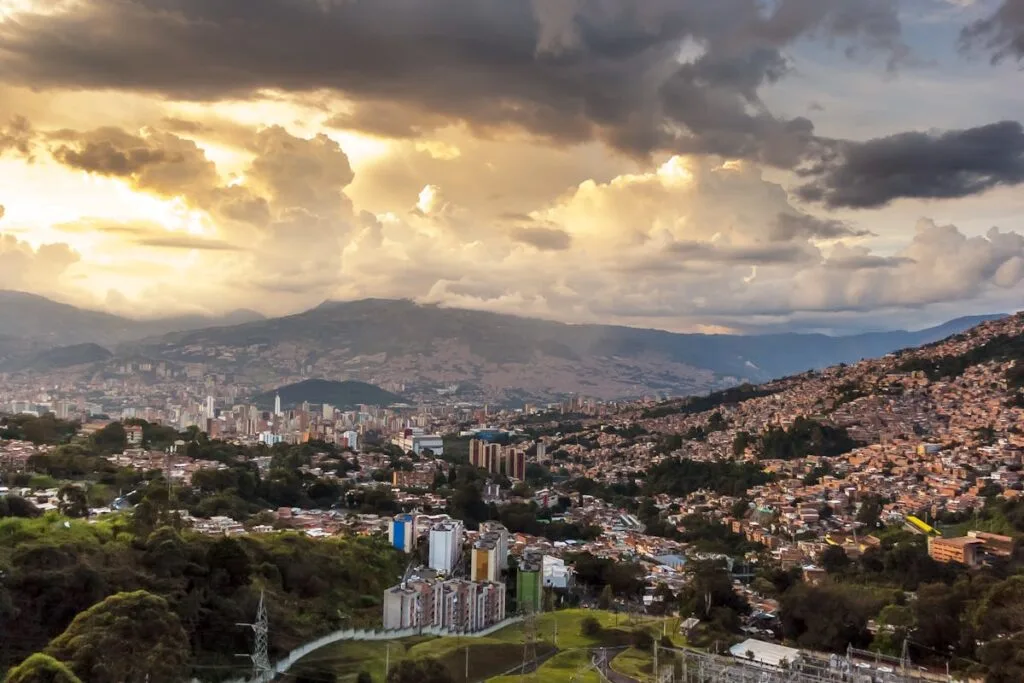
Medellín’s weather is the main draw for many: the city sits in a valley with mild temperatures most of the year, in the low 70s Fahrenheit (around 22 °C). El Poblado and Laureles are the two neighborhoods built around remote workers, with coworking spaces, walkable streets and a large expat community.
Cartagena is hot and generally more expensive, better suited to a stay of one to three months than a year-round base. Internet tends to be less consistent there than in Medellín or Bogotá, according to the original version of this article.
Bogotá is the cheapest of the three in the table and often underrated, with the largest food scene in the country. The trade-offs are the altitude, about 2,640 m (roughly 8,600 ft), and a cool, gray climate. For where to stay in Colombia in all three cities, the gap between budget and upscale is smaller than many expect.
Best Cities for Digital Nomads in Colombia
The visa gets you into Colombia, but the city decides what daily life looks like. For context, MinComercio figures relayed by Anato for October to December 2025 show Bogotá (around 112,000 tickets sold), Medellín (65,344) and Cartagena (62,236) as the top destinations; Bogotá’s lead partly reflects its role as the country’s main air hub. Every figure below that isn’t attributed comes from the original version of this article and should be checked.
Medellín — The Default Choice
- What it is: Colombia’s second city, in the Aburrá Valley, and the usual first stop for a digital nomad in Colombia. El Poblado is where most newcomers land: English menus, rooftop bars, everything a few blocks away, and higher prices. Laureles, flatter and more residential, is where longer-stay remote workers often move.
- Getting there: José María Córdova International Airport, in Rionegro, outside the valley; the drive into the city usually goes through a tunnel.
- What it costs: coworkings such as Selina, WeWork, Tinkko and Epicentro were quoted at $80–150 a month in the original article (check they’re still open and their current prices). Metro fare: around $0.70 per ride in the original article, to check against Metro de Medellín’s official fare. Apartment internet: 50–100 Mbps, with fiber on longer leases.
- Best time of year: mild all year; December and the Feria de las Flores in August draw the biggest crowds and prices.
- Watch out for: episodes of poor air quality when pollution gets trapped in the valley, monitored by SIATA and the Área Metropolitana del Valle de Aburrá.
- Source and more: the full guide to things to do in Medellín.
Bogotá — For the Grinders
- What it is: the capital, the economic center, and the strongest food scene in the country. Chapinero and Usaquén are the nomad neighborhoods, with cafes, transit and services.
- Getting there: El Dorado International Airport, the country’s main hub, with the most direct flights from North America.
- What it costs: the lowest monthly totals of the three cities in the cost table above (estimates, to check).
- Best time of year: the climate is cool and gray most of the year; the drier months are generally considered the more pleasant ones.
- Watch out for: altitude, about 2,640 m (8,600 ft in the original). It’s felt during the first days.
- Source: Aerocivil and IDEAM for airport and climate data; altitude to confirm with official city data.
Cartagena — Beach + Work
- What it is: the walled colonial city on the Caribbean, founded by Pedro de Heredia in 1533. Getsemaní is the neighborhood remote workers usually pick: walkable, more affordable than the walled center, with a creative streak. Works best in one-to-three-month stints.
- Getting there: Rafael Núñez International Airport, close to the center.
- What it costs: the highest monthly totals of the three cities in the table (estimates, to check).
- Best time of year: the dry months at the end and start of the year bring the crowds; the rest of the year is hot and humid.
- Watch out for: WiFi less reliable than in Medellín or Bogotá. Keep a backup hotspot for heavy call days.
- Source and more: the full rundown in the guide to things to do in Cartagena.
Santa Marta & the Caribbean Coast
- What it is: the emerging option on the coast. Cheaper than Cartagena, less crowded, more laid back, with Tayrona National Park and the Sierra Nevada nearby for weekend escapes.
- Getting there: Simón Bolívar International Airport, with domestic connections through Bogotá and Medellín.
- What it costs: generally lower than Cartagena, according to the original article; no official figure.
- Best time of year: the dry season brings crowds to Tayrona, which also closes for set periods each year. Check Parques Nacionales Naturales before planning a visit.
- Watch out for: thinner coworking infrastructure and inconsistent internet; bring a quality hotspot. Best for remote workers who work asynchronously and don’t need calls all day.
- Source: Parques Nacionales Naturales de Colombia for Tayrona closures and rules.
Day-to-Day Life on a Long Stay
Some practical facts shape a long stay more than the visa does.
Time zone. Colombia uses a single legal time, UTC-5, with no daylight saving time (the hora legal de Colombia, maintained by the Instituto Nacional de Metrología). In winter, that lines up exactly with Eastern Time: 9 a.m. in New York, Toronto or Montreal is 9 a.m. in Medellín. From March to November, when the US and Canada move to daylight time, Colombia is one hour behind the East Coast. For anyone with clients in North America, that’s still one of the best overlaps available.
Air quality. The Aburrá Valley, where Medellín sits, has recurring episodes of poor air quality when weather conditions trap pollution in the valley. SIATA and the Área Metropolitana del Valle de Aburrá publish real-time measurements and declare alerts. People sensitive to air pollution should follow those alerts before picking a month to arrive.
Administrative pace. Procedures take time: appointments at Migración Colombia, bank account openings, leases. Having the cédula, the visa printout and copies of documents ready saves trips. Build buffer time into any plan that depends on an office appointment.
Safety. The general advice applies: don’t show expensive gear, stay aware at night, use registered taxis or apps. The detailed, honest breakdown is in the guide on safety in Colombia.
Community. Coworking spaces and language exchanges in neighborhoods like Laureles and El Poblado are the usual ways remote workers meet people, both other foreigners and locals.
For a first-hand account of a long stay, the author’s own three months are in living in Medellín for 3 months.
Frequently Asked Questions
Can I live in Colombia as a US citizen without a visa?
Yes, up to 90 days per entry, extendable to 180 days per calendar year with a prórroga from Migración Colombia. Past 180 days in the same calendar year, you need a visa (Resolución 5477 of 2022, art. 46, parágrafo).
Do I need a visa to work remotely from Colombia?
Not if your passport is visa-exempt, you’re paid from abroad, and you stay within 180 days per calendar year. Resolución 5477 of 2022 lets digital nomads and remote workers in that situation enter with the entry permit granted at the border.
How much is a digital nomad visa for Colombia?
The confirmed official amount is the cédula, 294,000 COP (Migración Colombia, Res. 0599 of 2026). The study fee (~$52 USD in the original version) and the issuance fee aren’t confirmed: check Cancillería’s fee schedule before applying.
What income do I need for the Colombia digital nomad visa in 2026?
Three monthly minimum wages over the last three months: 3 × 1,750,905 COP = 5,252,715 COP per month (Decreto 159 of 2026, provisional). That’s roughly 1,590 to 1,640 USD at early October 2026 rates.
How long does the Colombia digital nomad visa take to process?
The original version of this article gave an official timeline of up to 30 calendar days, which couldn’t be confirmed on an official page. Faster turnarounds reported online are applicant reports, not an official commitment, so check with Cancillería.
Does the digital nomad visa lead to permanent residency in Colombia?
No. Article 90 of Resolución 5477, as modified by Resolución 10434 of 2023, lists the visas that count toward an R visa, and the V digital nomad visa isn’t among them. The spouse visa counts after 3 years.
How much do I need to invest in Colombia to get a visa?
For the M investor visa, foreign direct investment above 650 SMMLV (over 1,138,088,250 COP in 2026) or real estate worth at least 350 SMMLV (612,816,750 COP), per article 79 of Resolución 5477 as published in October 2026. Check with Cancillería before applying.
Which country has the easiest digital nomad visa?
There’s no official ranking, so this guide won’t invent one. What makes Colombia’s relatively simple: the whole application is online, and the income threshold is a clear multiple of the minimum wage. What makes it less simple: the threshold rises with the minimum wage every year, and some fees aren’t published clearly.
Can I work for a Colombian company on the digital nomad visa?
No. The resolution says the visa does not allow paid activity with any company or person domiciled in Colombia. A spouse visa, by contrast, comes with an open work permit.
Can I bring my family on the Colombia digital nomad visa?
The original version of this article said a spouse and dependent children can apply for beneficiary visas tied to the nomad visa, each with a separate application on the Cancillería portal. That couldn’t be confirmed in the official text consulted, so check with Cancillería before applying.
Can I leave and re-enter Colombia on the digital nomad visa?
The original version said the visa allows multiple entries; check the visa document itself. Keep the visa printout and your cédula with you when you travel, and note that a valid visa waives the Canadian entry fee.
What happens if my visa is denied?
The study fee is generally not refunded. Common reasons include insufficient income proof, incomplete documents, or insurance that doesn’t cover the required risks or duration. You can apply again once the issues are fixed.
Can I switch from a tourist stamp to the digital nomad visa while in Colombia?
According to the original version of this article, yes: you can apply online through the same portal while in Colombia as a visitor. Resolución 5477 requires that you stay in regular status while the application is studied (art. 97), so don’t let your permit expire before a decision.
How much does it cost a Canadian to enter Colombia?
270,000 COP per entry, according to Migración Colombia’s Resolución 0599 of February 10, 2026. Children under 14, people over 79 and holders of a valid Colombian visa are exempt, among others.
Rules checked against Cancillería (Resolución 5477 of 2022, Normograma version) and Migración Colombia (Resolución 0599 of 2026) in October 2026. This is not legal advice: confirm your case with Cancillería or the Colombian consulate before applying.