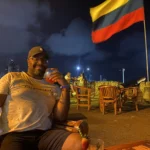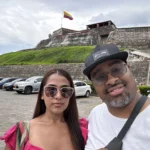
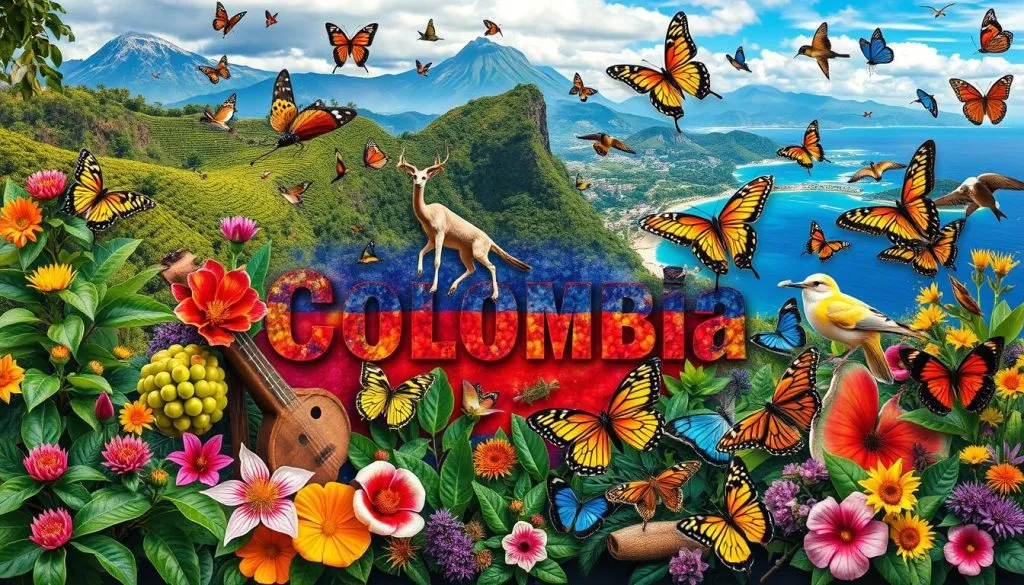
So here’s the thing about fun facts about Colombia: most lists online were written by people who spent a week here, or never came at all. I’ve been going back since 2021. The first time, I landed in Medellín for three months without knowing anyone and without speaking Spanish, first time in Latin America, and all the people said that I am crazy. Today I rent an apartment in Santa Marta with my girlfriend, both our names on the lease, and I still have a long list of places I haven’t seen.
So this is a list of 28 interesting facts about Colombia, and every single one names its source: UNESCO, SiB Colombia, the FNC, DANE, the IUCN, Banco de la República and a few others. Where I was actually there, I tell you what I saw. Where I wasn’t, I say so. For scale: Colombia has more than 52 million people, according to the population projections of DANE, the national statistics office.
If you’re planning the bigger trip, my list of things to do in Medellín is a good place to start.
Key Takeaways
- Colombia is the second most biodiverse country on Earth and number one for birds and orchids (facts 3 to 5).
- Two coasts, three Andean ranges, the Amazon and a “desert” that is really a dry forest (facts 1, 8, 10 and 11).
- Coffee, emeralds and flowers are the three things Colombia sends to your kitchen, your jewelry box and your Valentine’s Day (facts 14 to 17).
- Medellín’s transformation and Cartagena’s walls are two of the best stories in the country (facts 18 and 22).
- The peso has gotten a lot stronger since 2021, which changes the math for long stays (fact 28).
1. Colombia Is the Only South American Country With Both a Pacific and a Caribbean Coast
Colombia is the only country in South America with coastline on both the Pacific Ocean and the Caribbean Sea. According to the CIA World Factbook, that’s about 1,760 km on the Caribbean side and about 1,448 km on the Pacific side.
I’ll be honest: I only know the Caribbean side. Santa Marta, Taganga, Cartagena, Barranquilla. The Pacific coast is still on my list.
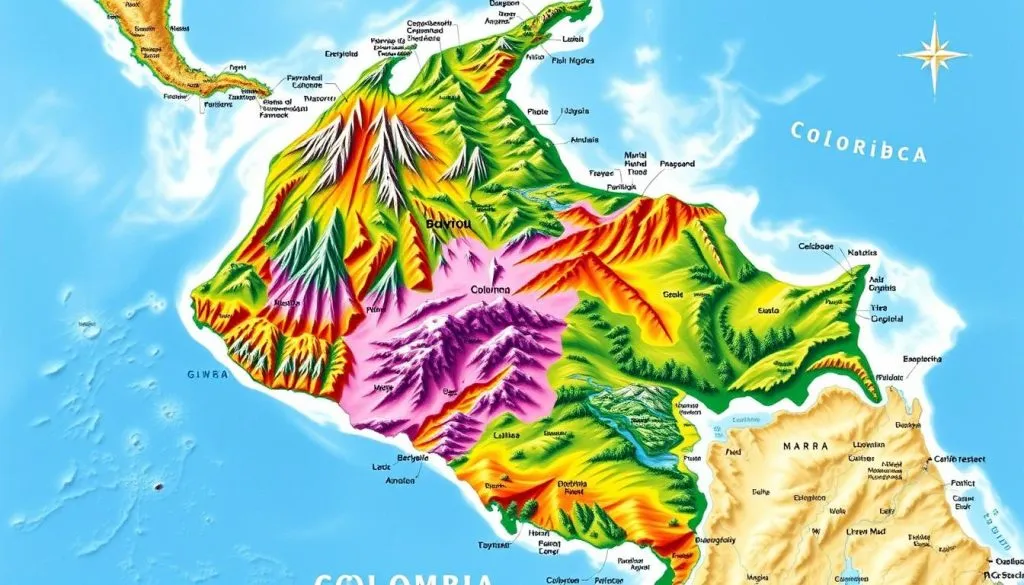
| Region | Highlights | Ecosystem |
|---|---|---|
| Caribbean Coast | Beaches, colonial cities, island trips | Tropical |
| Andes Mountains | Three mountain ranges, coffee country, cool cities | Alpine to temperate |
| Amazon Rainforest | Rivers, rare species, Leticia and Puerto Nariño | Tropical Rainforest |
| Tatacoa Desert | Ochre-hued canyons, arid landscapes | Tropical dry forest |
For where to actually go in each region, I put together the best places to visit in Colombia, from beaches to mountains.
2. Its Official Name Is the Republic of Colombia, and It Was Named After Columbus
The official name of Colombia is the República de Colombia, the Republic of Colombia, as written in the 1991 Constitution. The country is named after Christopher Columbus, and the funny part, as Britannica tells it, is that Columbus never actually set foot on what is Colombia today.
The name changed a lot before it stuck. There was Gran Colombia (1819 to 1831), then the Republic of New Granada, then the United States of Colombia (1863 to 1886), and finally the Republic of Colombia from 1886.
3. It’s the Second Most Biodiverse Country on Earth
Colombia has the second-highest biodiversity in the world, surpassed only by Brazil. That’s the claim you’ll see everywhere, and the official counter backs it up: the SiB Colombia, the national biodiversity information system run with the Instituto Humboldt, counted 80,346 species in the country as of December 31, 2024. The Convention on Biological Diversity’s country profile also lists Colombia among the world’s “megadiverse” countries.
Basically: two oceans, three branches of the Andes, the Amazon, the Orinoco plains and glaciers, all in one country.
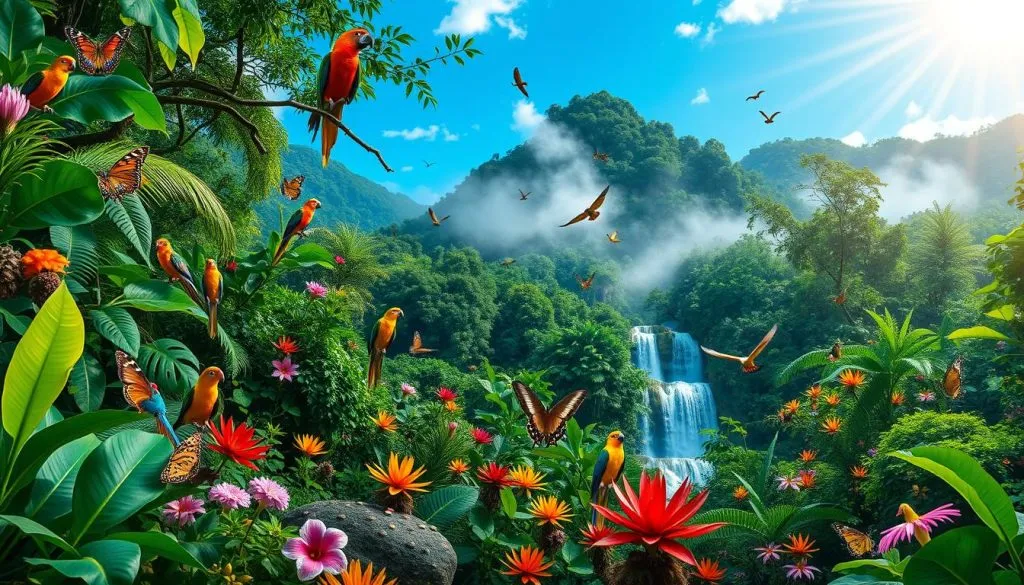
Some of the species people come looking for: the spectacled bear in the Andean forests (fact 6), the wax palm (fact 7), the pink river dolphin (fact 8), and the plumed basilisk, the “Jesus Christ lizard,” which runs on water in certain regions.
4. Colombia Has More Bird Species Than Any Other Country
Here’s one of the best Colombia fun facts: no country on Earth has more bird species. The old version of this article said “over 1,900,” and that’s still true, but the national count keeps climbing toward 2,000. SiB Colombia ranks the country first in the world for birds, and the Asociación Colombiana de Ornitología keeps the official checklist.
Colombia also has a habit of winning the Global Big Day, the one-day world bird count organized by eBird and the Cornell Lab of Ornithology. According to ProColombia’s reports of the results, Colombia came first in 2017, 2018, 2019, 2020, 2022 and 2024, with 1,558 species recorded in a single day in 2024.
5. It Also Holds the Record for Orchids, Including Its National Flower
Colombia is also number one for orchids. The Ministerio de Ambiente reports 4,270 registered orchid species, 1,572 of them found nowhere else.
The national flower is one of them: the Cattleya trianae, also called the flor de mayo. The ministry says it was chosen by the Academia Colombiana de Historia in 1936, on the recommendation of botanist Emilio Robledo. It’s named after the Colombian naturalist José Jerónimo Triana.
6. Colombia’s National Animal Is the Andean Condor
So, the Colombia national animal is the Andean condor. It sits on top of the national coat of arms, adopted by Ley 3 of 1834, holding a laurel wreath. The sad part: the bird itself is in trouble. The IUCN Red List classifies Vultur gryphus as Vulnerable,.
The original version of this article also called the spectacled bear “endangered.” That’s not quite right. The spectacled bear, the only bear species native to South America, is listed by the IUCN as Vulnerable, one step below Endangered. Still threatened, still worth protecting, just not the category we wrote before.
7. The National Tree Is the Tallest Palm in the World
Colombia’s national tree is the wax palm, Ceroxylon quindiuense, made official by Ley 61 of 1985. It’s considered the tallest palm in the world, growing up to around 60 meters, and conservation groups list it as threatened.
The place everyone goes to see them is the Valle de Cocora, in Quindío, near Salento in the coffee region. The Gobernación del Quindío and Parques Nacionales both promote it. I haven’t been to Cocora yet.
8. The Amazon Covers Over 40% of Colombia, and Pink River Dolphins Live There
This one surprises a lot of people who think of Colombia as beaches and coffee: the Amazon region covers about 42% of the country’s territory, according to the Instituto SINCHI, the government’s Amazon research institute. It’s part of the biggest tropical rainforest in the world, and it’s home to rare animals like jaguars and pink river dolphins.
That pink dolphin, Inia geoffrensis, is listed as Endangered by the IUCN since 2018. WWF Colombia runs research and counts on the river dolphins of the Colombian Amazon.
The usual entry point is Leticia, the city at the border with Brazil and Peru, and the small town of Puerto Nariño upriver. You fly in: there’s no road from the rest of the country. I haven’t been, so I won’t pretend to tell you what the river feels like.
9. Caño Cristales Turns Red, Yellow, Green, Blue and Black
Caño Cristales, in the Serranía de La Macarena, is the river people call “the river of five colors.” The red comes from an aquatic plant, Macarenia clavigera, that grows on the riverbed and turns color when the water level and the sun are right. Add yellow sand, green algae, blue water and black rock, and you get the five.
It’s protected inside the Sierra de La Macarena National Park, managed by Parques Nacionales Naturales together with Cormacarena. The river is only open to visitors part of the year, usually from around mid-year to late in the year, so check the official dates with them before you book anything.
10. The Tatacoa Desert Isn’t Technically a Desert
The Tatacoa Desert is a place of red canyons and dry lands, and here’s the cool fact about it: it’s not technically a desert. It’s a tropical dry forest that dried out over time, as the Gobernación del Huila and Colombia Travel (ProColombia) explain. The landscape just looks like one.
It’s in the department of Huila, north of the city of Neiva, southwest of Bogotá. The sky is so clear at night that there’s an astronomical observatory there, and stargazing is one of the main reasons people go.
11. The Sierra Nevada de Santa Marta Is Often Called the World’s Highest Coastal Mountain Range
The Sierra Nevada de Santa Marta goes from the Caribbean Sea to snow-capped peaks of about 5,700 meters, roughly 42 km from the coast. Older surveys give 5,775 meters for Pico Cristóbal Colón, newer measurements say closer to 5,700, and nobody has settled whether Cristóbal Colón or Simón Bolívar is the taller peak. UNESCO declared it a biosphere reserve in 1979.
Now the Canadian twist: it’s often called the highest coastal range in the world, but some sources point out that the Saint Elias Mountains, on the Yukon and Alaska border, are taller. What nobody argues with is that it’s the highest coastal range in the tropics.
I’ve seen the bottom of it. Parque Tayrona, a national park, not a town, sits right where the mountain meets the sea. I went in 2024, almost two hours of walking and a bit on horseback to reach Cabo San Juan, and I think I paid 90,000 COP at the foreigner rate. I loved it. The boat back was another story: a big fast boat in deep water, and some of my photos almost scare me now. My advice: go back by land, take a bigger boat, or sleep there in a tent. I’ve also been up to Minca, in the same mountains.
12. Santa Marta Is the Oldest Surviving City in Colombia
Santa Marta was founded in 1525 by the Spanish conquistador Rodrigo de Bastidas, which makes it the oldest surviving city in Colombia, according to Britannica and the Alcaldía de Santa Marta. Cartagena came eight years later. It’s also where Simón Bolívar died, in 1830, at the Quinta de San Pedro Alejandrino.
This is my city now, sort of. I’ve been coming back since 2022, and since 2025 I rent an apartment here with my girlfriend, both of our names on the lease, monthly payment. Rent, not own. My Santa Marta is the mercado that opens at 4:30 in the morning and is basically done by 9 or 10, small places for breakfast, and fish and seafood at little beach restaurants built with two or three planks.
Taganga is right next door, and I go often. Honestly, it’s not the best beach, and that’s a shame, because the view, mountain and sea together, is paradise. I still go for the whole thing: eat, look, swim.
13. Colombia Has No Four Seasons: Altitude Decides the Weather
Colombia sits close to the equator, so there’s no winter or summer the way we have in Canada. Altitude decides the temperature. IDEAM, the national weather institute, uses “pisos térmicos,” thermal floors: hot at sea level, temperate in the middle (Medellín), cold up high (Bogotá), and páramo above that. What changes during the year is rain, not heat.
So what’s the best time to visit Colombia? In much of the Andes and the Caribbean, the drier periods are usually December to March and June to August, but it varies by region, so check IDEAM for where you’re going.
The Caribbean region has a warm, tropical climate all year, between 75°F and 90°F (24°C to 32°C). The Andes are cooler, sometimes below 50°F (10°C) at high elevations. The Amazon is humid and rainy, especially from April to November. The desert of La Guajira is dry, with very little rain.
| Region | Average Temperature | Rainfall | Best Time to Visit |
|---|---|---|---|
| Caribbean Coast | 75°F – 90°F (24°C – 32°C) | Low during dry season, high during rainy season | December to March |
| Andes Mountains | 50°F – 70°F (10°C – 21°C) | Moderate, with some variation by region | Year-round, depending on activities |
| Amazon Rainforest | 70°F – 90°F (21°C – 32°C) | High all year, heaviest roughly April to November | June to August: wet season tapering, but expect rain anytime |
| La Guajira Desert | 80°F – 100°F (27°C – 38°C) | Very low | December to March |
Seasonal tips: the dry season (December to March) is great for beaches; the rainy months are greener in the Andes and the Amazon, so bring rain gear; and the coffee harvest (often October to December, depending on the region) is when you see the picking. For the coast specifically, here’s the best time to visit Cartagena.
14. Colombia Is One of the World’s Top Coffee Producers, and Juan Valdez Isn’t Real
Colombia usually ranks third among the world’s coffee producers, behind Brazil and Vietnam, according to the production figures of the International Coffee Organization, and it’s known above all for washed arabica. The Federación Nacional de Cafeteros (FNC), founded in 1927, represents hundreds of thousands of growing families.
One of the fun facts about Colombia culture: Juan Valdez, the guy with the mustache and the mule, isn’t a real farmer. He’s a character the FNC created in the late 1950s to sell 100% Colombian coffee abroad, and he became a café chain later.
The Coffee Triangle (Caldas, Quindío and Risaralda) is the heart of it, with Nariño, Huila and Antioquia as other big regions, each with its own soil. The common varieties are Bourbon, Caturra and Castillo. The methods stay traditional:
- Manual harvesting: farmers pick only the ripe cherries by hand.
- Wet processing: the beans are washed and fermented to remove the fruit.
- Sun-drying: the beans dry in the sun.
Colombia has a main harvest and a smaller one called the mitaca, and their timing depends on the region, the FNC explains.
15. The Coffee Region Is a UNESCO World Heritage Site
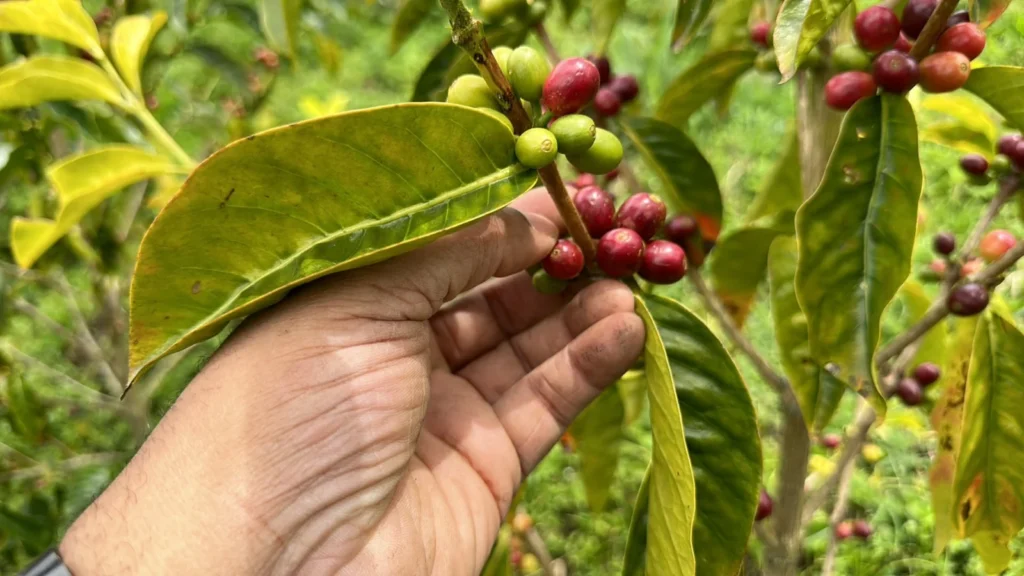
Coffee cherries at a plantation in Jardín, 2022.
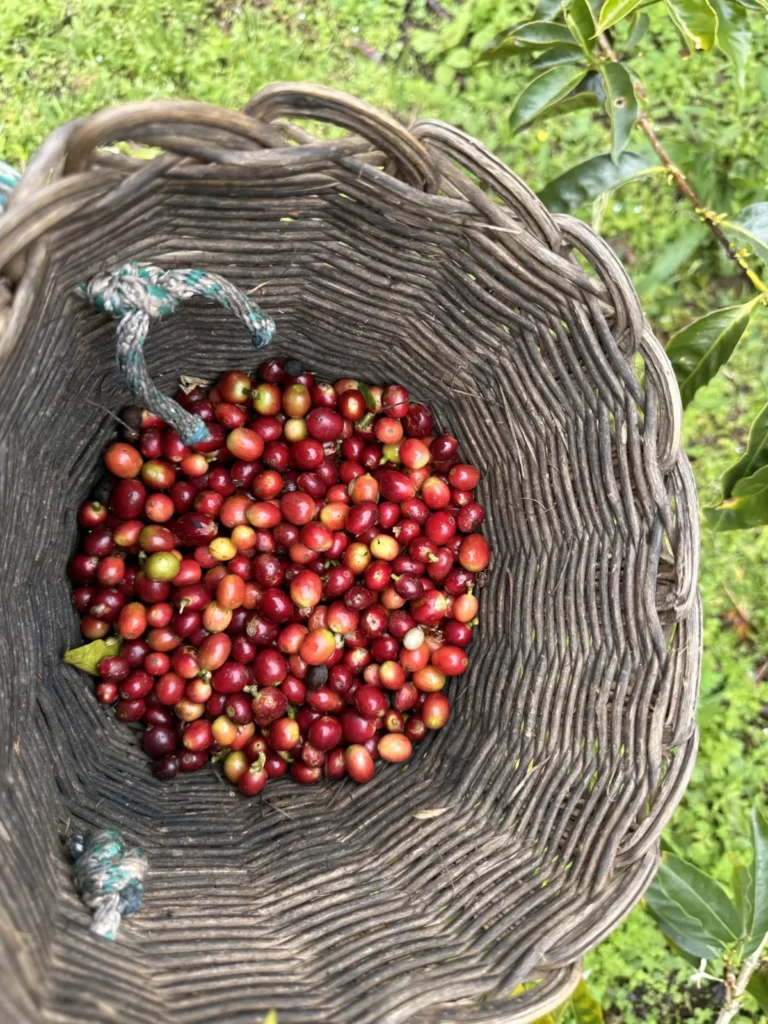
A basket of coffee cherries, Jardín, 2022.
The coffee country itself is protected. UNESCO inscribed the Coffee Cultural Landscape of Colombia on the World Heritage List in 2011 (reference 1121): farms on steep slopes, small towns with colored balconies, and a way of farming passed down through generations across Caldas, Quindío, Risaralda and Valle del Cauca.
Coffee tourism grew around it. These are the kinds of experiences you’ll find, prices vary from farm to farm:
| Coffee Tourism Experiences | Highlights |
|---|---|
| Coffee Plantation Tours | Guided walks through big coffee farms, learning how coffee is grown |
| Barista Workshops | Hands-on lessons in brewing and serving the perfect Colombian coffee |
| Cupping Sessions | Guided tastings to learn about the unique flavors of different coffee types |
16. Colombia Produces More Emeralds Than Any Other Country
Colombia is the emerald country. A USGS report on gemstones estimated that from 1995 to 2005, Colombia produced about 47% of the world’s emeralds by volume, ahead of Zambia and Brazil. The USGS also says value figures are hard to estimate, so be careful with the “70 to 90 percent” numbers you’ll see on other sites: they’re not from them. The Agencia Nacional de Minería regulates the sector.
The most famous mines are around Muzo, in Boyacá. And here’s the link with Cartagena: the Spanish shipped gold and emeralds out through that port, which is exactly why they walled it in. More on that in fact 22.
17. That Valentine’s Day Rose Was Probably Grown in Colombia
Colombia is the second-biggest flower exporter in the world, behind the Netherlands. The growers’ association Asocolflores has said that three out of every four flowers sold in the United States come from Colombia. A lot of them grow in greenhouses on the high plain around Bogotá.
The flower culture shows at home too. Medellín’s Feria de las Flores, in August, is the city’s biggest festival, with the silleteros carrying huge flower arrangements on their backs. Current import data: the USDA and the US Census Bureau.
18. Medellín Went From Most Dangerous City to Most Innovative City
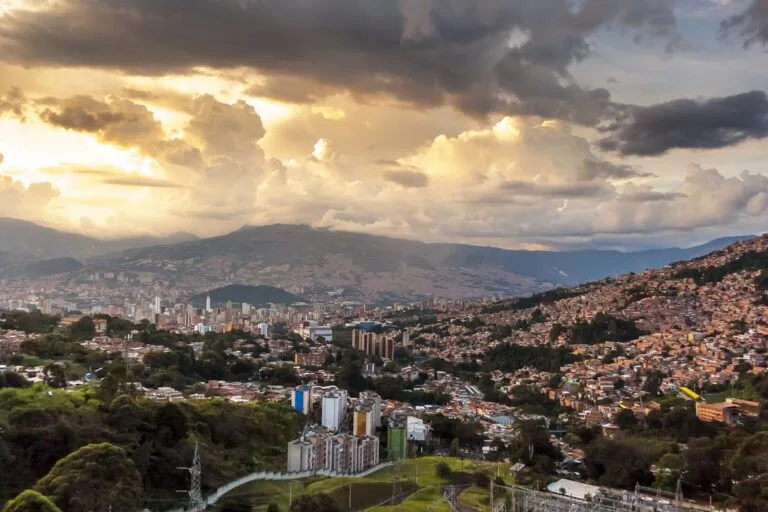
Medellín’s story is a big part of Colombia history. Once plagued by violence, the city was named the most innovative city in the world in 2013, in the “City of the Year” competition run by the Wall Street Journal, Citi and the Urban Land Institute.
A lot of that came from fixing infrastructure. The Metro de Medellín opened the Metrocable, cable cars that work as public transit, in 2004, linking hillside neighborhoods to the metro. Then came parks, walkable streets, education and community programs, plus festivals, museums and street art.
I lived it from the inside for three months in 2021: first in El Poblado, then in Laureles for the last two months, Spanish school Monday to Friday, work on my laptop from 8 a.m. to 8 p.m., Rappi for dinner. I took the Metrocable up to Parque Arví and I did the Comuna 13 tour. More on that in living in Medellín for three months and my list of the best things to do in Medellín.
19. Bogotá Closes Over 120 km of Roads to Cars Every Sunday
Every Sunday and holiday, Bogotá closes more than 120 km of streets to cars for the Ciclovía, and the streets fill with bikes, runners and skaters. It’s been going since 1974, according to the city’s sports and recreation institute, the IDRD. Cycling keeps growing all over the country, with more bike lanes, bike sharing and bike tours.
For getting around the rest of Colombia:
- Domestic flights: Avianca and LATAM fly between the major cities. (Viva Air, which the old version of this article mentioned, stopped operating in 2023.)
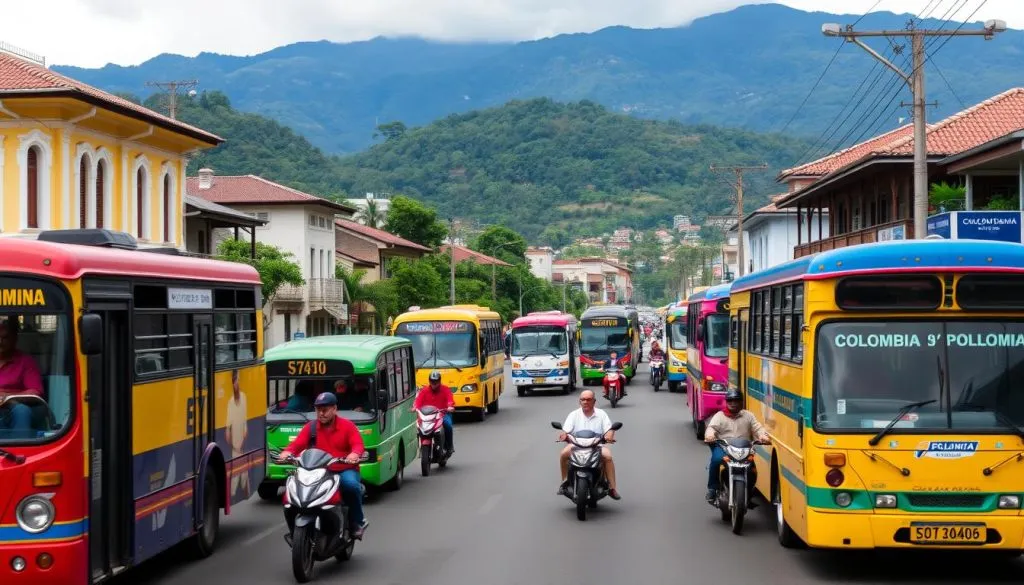
- Buses: the long-distance bus network covers the whole country and is the budget option.
- City transit: Medellín has a metro and Metrocable, Bogotá runs the TransMilenio bus rapid transit system (its first metro line is still under construction), and Cali has the MIO buses.
- Colectivos: shared minibuses on set routes, a good way to see local life up close.
- Taxis and apps: easy to find; agree on the price before you get in.
20. Spanish Isn’t the Only Official Language: 68 Native Languages Are Recognized
One of the less-known facts about Colombians: Spanish is the main language, but it isn’t the only official one. Article 10 of the 1991 Constitution makes the languages of ethnic groups official in their own territories, and Ley 1381 of 2010 protects them. The Ministerio de Cultura counts 68 native languages: 65 indigenous languages, two creoles (Palenquero and the creole of San Andrés) and the Romani language.
Spanish is still what you’ll hear everywhere, and some English in tourist areas. I learned that the hard way. I landed in Medellín not speaking Spanish at all, so I signed up for Spanish school Monday to Friday. Even a little helps, and it shows respect. I still ask the basic questions without shame.
21. San Basilio de Palenque Was the First Free Town in the Americas
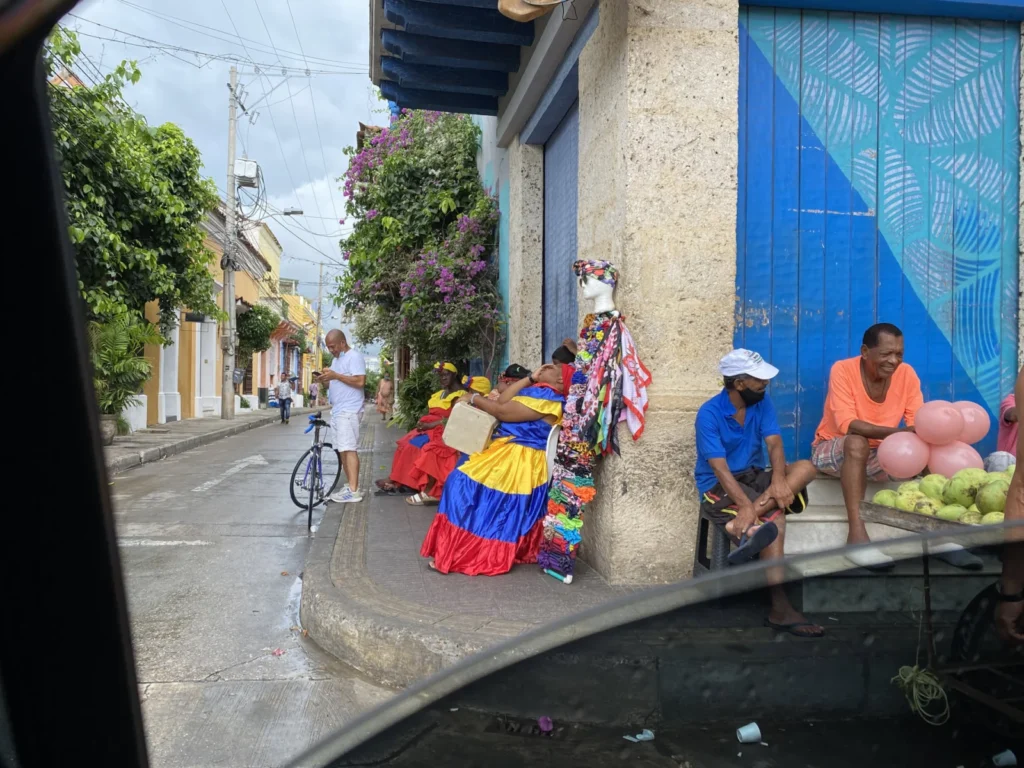
Palenqueras in Cartagena, 2021.
Near Cartagena, in the department of Bolívar, San Basilio de Palenque is widely described as the first free town in the Americas. It was founded by Africans who escaped slavery, linked in tradition to the leader Benkos Biohó, and the Spanish Crown eventually had to recognize its freedom (historians cite different dates for that decree).
UNESCO proclaimed the cultural space of Palenque de San Basilio a Masterpiece of the Oral and Intangible Heritage of Humanity in 2005. It kept its own language, Palenquero (fact 20), plus its music and rites. I haven’t been yet.
22. Cartagena’s Walls Were Built by the Spanish to Keep Out Pirates
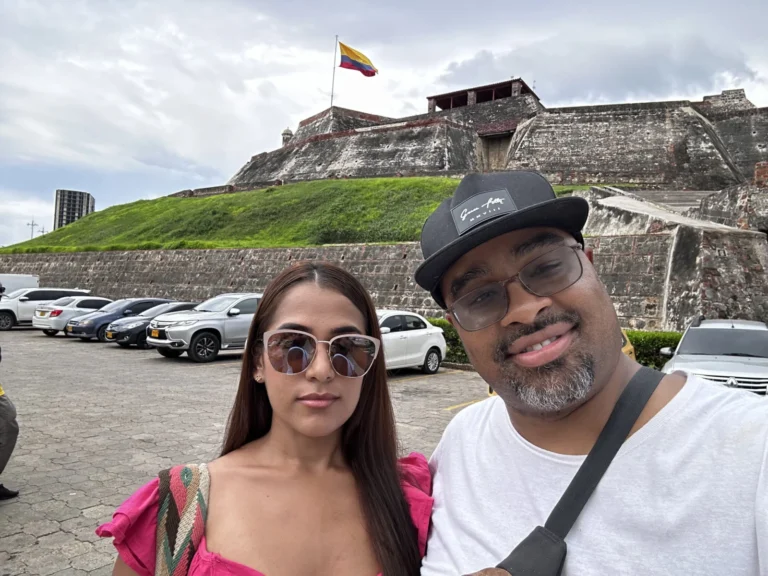
Cartagena de Indias was founded by the Spanish conquistador Pedro de Heredia in 1533. The Spanish built its walls from the late 16th century into the 18th century to defend the port against pirates and rival powers, and with good reason: Francis Drake took the city and held it for ransom in 1586. The big fort is the Castillo San Felipe de Barajas, not the “Castillo de San Marcos” the old version of this article named (that one is in Florida). UNESCO inscribed the port, fortresses and monuments in 1984.
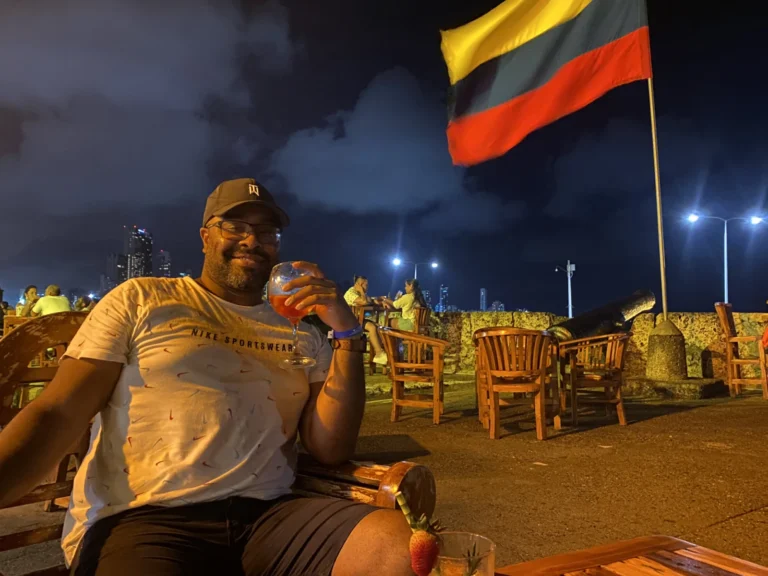
I’ve been to Cartagena at least four times. I stayed right in El Centro, at a corner near Avenida Santo Domingo, and I walked the walls: you can go around, but one part is closed to the public. People live on and along them, there are hotels and restaurants, it’s not a museum. Inside the walls are the “cuevas,” small rooms where cannons fired out to sea. A local friend once told me, on camera, that indigenous people built the walls to fight the Spanish. I doubted it out loud, and I was right to: the facts are above. One time I also walked from Bocagrande to the Castillo, but I’ve never been inside it.
Here’s that day on the walls on my channel:
At night, a lot of people dress in white. A local explained it’s the climate: white is comfortable, and a white shirt with the sleeves rolled up replaces the jacket and tie. Want the whole story? Read the history of Cartagena.
23. Two Colombian Festivals Are on UNESCO’s Heritage List
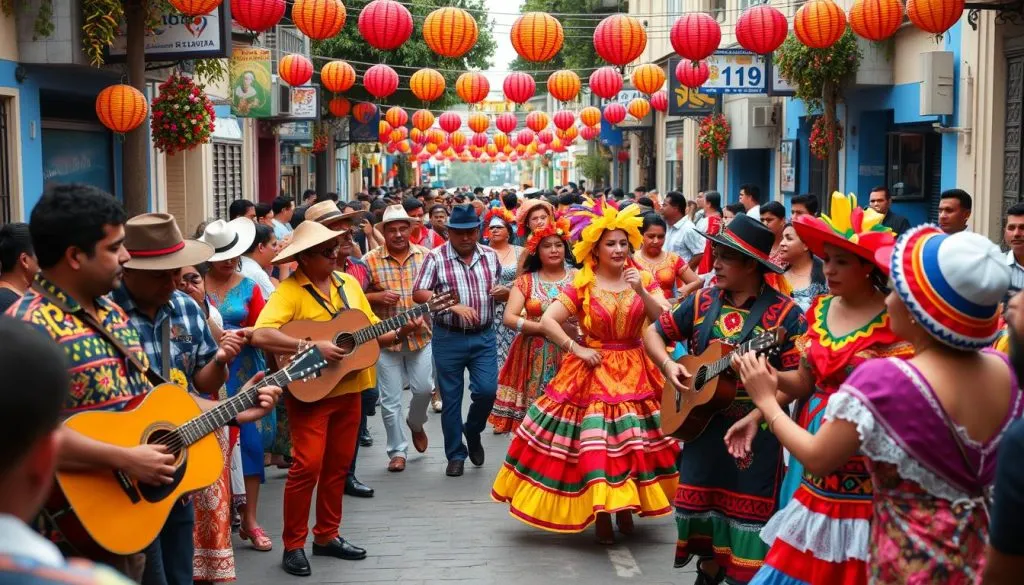
Colombia’s culture is full of festivals, and two of them are recognized by UNESCO. The Carnaval de Barranquilla was proclaimed a Masterpiece of the Oral and Intangible Heritage of Humanity in 2003. It happens every year before Lent, with costumes, music and dances like the marimondas and the cumbia. The Holy Week processions of Popayán were added to UNESCO’s list in 2009, with rituals, sacred music and devotion.
There’s also the Día de las Velitas, on December 7, the eve of the Feast of the Immaculate Conception, when families light candles and lanterns on sidewalks and balconies, according to the Ministerio de Cultura.
Full honesty: I’ve been to Barranquilla, but only day trips by car. I’ve never been to the Carnival, so I can’t tell you what it feels like inside.
24. Vallenato and Marimba Music Are Protected by UNESCO
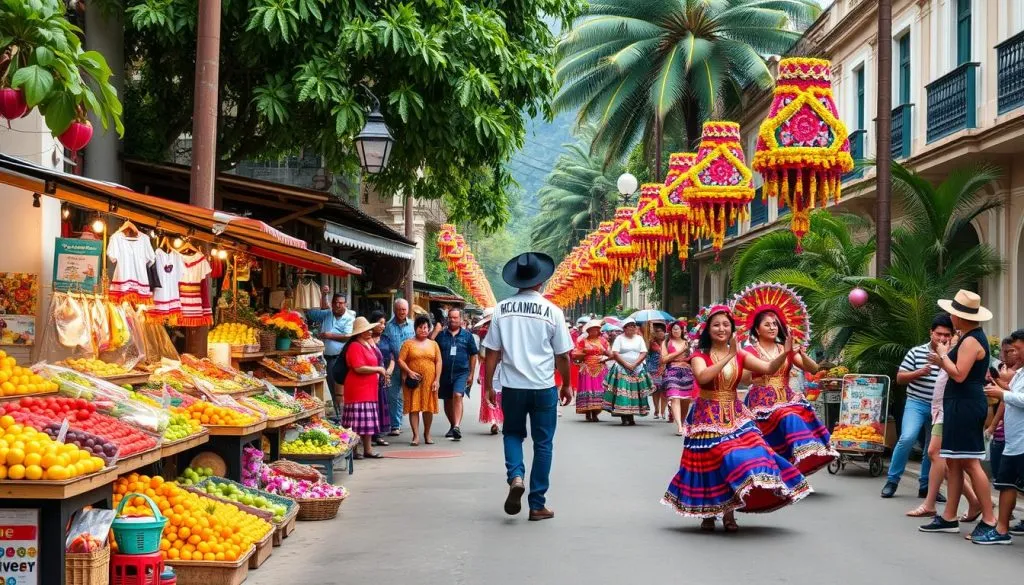
Music connects all of Colombia’s regions, and UNESCO protects two traditions. Vallenato, the accordion music of the Caribbean north, was added to the list of heritage in need of urgent safeguarding in 2015. Marimba music and traditional chants of the South Pacific were inscribed in 2010, and the listing was extended to Ecuador in 2015.
The main styles you’ll hear:
- Cumbia: a dance from the coast, with African, Indigenous and Spanish roots, and a symbol of national identity.
- Vallenato: storytelling music with the accordion, the caja drum and the guacharaca.
- Bambuco: an Andean rhythm, often played with the tiple guitar and the bandola.
- Currulao: from the Pacific coast, built on the marimba, with African and Indigenous influences.
After a night of tejo in Medellín (fact 26), my Spanish school took us to a salsa club: no class, just people who come to dance.
25. A Colombian Won the Nobel Prize in Literature
Gabriel García Márquez won the Nobel Prize in Literature in 1982, best known for One Hundred Years of Solitude (Cien años de soledad). He was born in Aracataca, in the department of Magdalena, the same department as Santa Marta.
26. The National Sport Involves Throwing Metal at Gunpowder
Here’s my favorite cool fact about Colombia: the national sport, by law (Ley 613 of 2000), is tejo. You throw a heavy metal disc at a clay board from a distance, and in the clay there are small paper packets of gunpowder. Hit one and it explodes. Boom.
I played it in Medellín, on an activity night organized by my Spanish school. The game is simple, but it’s really about the people: everyone laughing, drinking, music in the background. Honestly, there’s nothing like it back home in Canada. I wrote the whole night in playing tejo in Medellín.
27. Colombians Eat Plantain in Every Form, and I’m Not Complaining
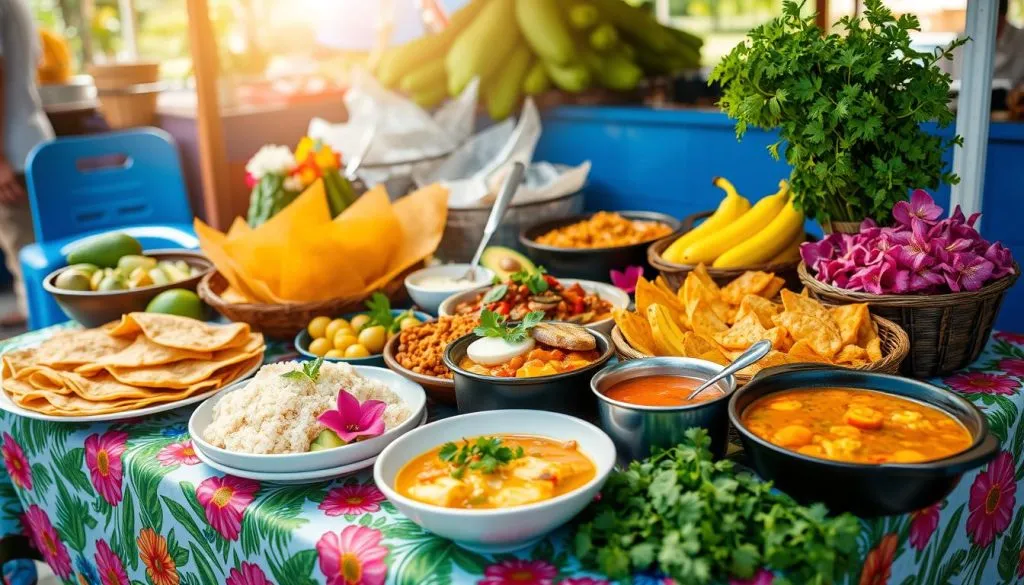
The fun facts about Colombia food start with my favorite food in life: plantain. I’d trade meat for plantain, and in Colombia you get it verde (green, for patacones), pintón (halfway) and maduro (ripe and sweet). The patacón is the cousin of the Haitian bannann peze, but in Haiti it’s spicier, and we serve it with pikliz.
Colombian cuisine mixes Indigenous, African and European roots. My first Colombian meal was a bandeja paisa, the big plate with beans, rice, meat, egg, arepa and more, on an outing with my Spanish school in Medellín’s El Centro. Try the ajiaco too, a warm potato soup from Bogotá, and fruits like lulo and maracuyá. I’m addicted to the fresh juices pressed on the street.
What I noticed, at least in what I’ve known: people eat heavy here, a lot of starch and not many vegetables on the plate, even with a huge range of local fruits and vegetables. My girlfriend’s family cooking from Norte de Santander is like that too.
Aguardiente is everywhere, but it has no official “national drink” status. What the law does say (Ley 1816 of 2016) is that each department controls its own liquor monopoly. On the coast, my beers have been Club Colombia, Stella, Heineken and the small Costeñita.
28. The Peso Has Strengthened a Lot Since 2021
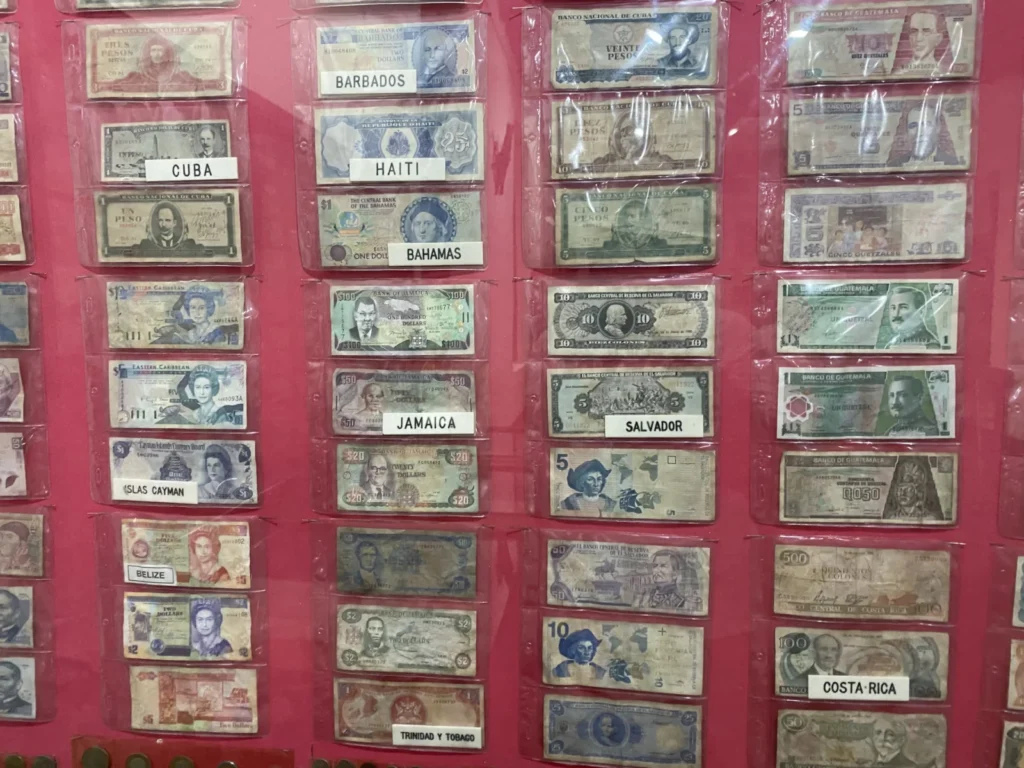
The banknote display at La Popa, Cartagena, 2021. My two worlds in one display case.
The currency is the Colombian peso (COP). The official rate is the TRM (Tasa Representativa del Mercado), certified every day by the Superintendencia Financiera and published by Banco de la República, which also designs the bills with their famous faces.
Here’s where my five years help. I think in Canadian dollars. In 2021, when I first landed, 1 CAD got me more than 3,000 pesos, somewhere around 3,100 to 3,300. Now it feels like 2 to 1. So Colombia got a lot less cheap for long stays, and at the mercado in Santa Marta some prices look like Canadian prices. Still, a vendor in El Rodadero sold me about two liters of lime juice for 5,000 COP.
| Date | Rate | Source |
|---|---|---|
| June 2023 | 1 USD = about 4,150 to 4,310 COP (moved during the month) | Daily TRM, Superintendencia Financiera |
| October 1, 2026 | 1 USD = 3,312.84 COP | TRM, Superintendencia Financiera |
| Today | Check the day’s TRM | banrep.gov.co |
(The old version of this article said “1 USD = 4,680 COP, as of June 2023.” That was too high for June 2023, so we corrected it. We also removed the old euro figure: check the current rate before your trip.)
Fun bonus from La Popa, the hill with the church above Cartagena: after the church there’s a small museum with bills from all over the world. I found old Canadian bills we don’t even use anymore, and a Haitian 25-gourde bill. That’s kind of really cool.
Here’s that visit on my channel:
Practical Colombia Facts Before You Go
A few interesting things about Colombia that are useful before you land.
| Key Fact | Value |
|---|---|
| Time Zone | UTC-5 all year, no daylight saving time. Same as Eastern Standard Time in the US and Canada (one hour behind Montreal in summer). |
| Electricity | 110–120V, 60Hz, plug types A and B, the same as the United States and Canada. |
| Tipping | Restaurants usually add a “propina voluntaria” of 10%. By law (Ley 1935 of 2018) it’s optional: they have to ask you. Taxi drivers don’t expect tips, but rounding up is appreciated. |
Money. Visa and Mastercard work in big cities and tourist areas, American Express less often, and there are plenty of ATMs. Tell your bank you’re traveling. But carry cash: one day in Cartagena, mango vendors everywhere and no cash on me, I ended up looking for a Davivienda ATM.
Entry. I travel on a Canadian passport and enter as a visitor, which gives me up to 90 days. As a Canadian, I pay an entry fee that guides written for Americans never mention, so check Migración Colombia and your airline for the current rule before you fly.
Taxis. In Cartagena, the driver will try to pull a fast one. Agree on the price before you get in, or use an app.
Parks and churches. My own observation: almost every park in Colombia faces a church. In Cúcuta I had lime juice near the main park, right across from the church.
Safety. Colombia is safer than its reputation, but stay alert in cities. Don’t show off expensive things, stick to lit and busy streets at night, use trusted taxis or apps, and talk to local guides before going to rural areas. Keep emergency numbers and your embassy’s contact handy. Read is it dangerous to travel to Colombia and the solo traveler’s guide to Colombia safety.
| Safety Tip | Importance |
|---|---|
| Avoid flaunting valuable items | Reduces the risk of theft or mugging |
| Stick to well-lit, populated areas | Enhances personal safety in urban environments |
| Research local emergency contacts | Ensures you can quickly access help if needed |
| Consult with local guides for rural travel | Provides valuable insights and safety recommendations |
FAQ
What is the most interesting thing about Colombia?
For me, it’s the biodiversity: Colombia is the second most biodiverse country in the world and number one for birds and orchids, according to SiB Colombia. Add two coasts, the Andes and the Amazon in one country, and you see why (facts 1, 3, 4 and 5).
What is Colombia’s national animal?
The Andean condor. It sits on top of the national coat of arms, adopted in 1834, and the IUCN Red List classifies it as Vulnerable. Even the national symbol needs protecting (fact 6).
What is the best time to visit Colombia?
It depends on the region, because altitude decides the temperature. In much of the Andes and the Caribbean, the drier periods are usually December to March and June to August, according to IDEAM. December to March is the classic beach season on the coast (fact 13).
What is the official name of Colombia?
The Republic of Colombia, or República de Colombia, as written in the 1991 Constitution. The name honors Christopher Columbus, who never set foot there. The country was also called Gran Colombia, New Granada and the United States of Colombia before 1886 (fact 2).
What food is Colombia famous for?
The bandeja paisa, ajiaco, arepas, and plantain in every form: patacones, maduros and more. Add fresh juices like lulo and maracuyá, and of course coffee. Expect heavy plates, with a lot of starch (facts 14 and 27).
What language do they speak in Colombia?
Spanish is the main language, but the 1991 Constitution also makes ethnic languages official in their territories. The Ministerio de Cultura recognizes 68 native languages: 65 indigenous languages, two creoles and Romani. In tourist areas, you’ll find some English (fact 20).